32 Beautiful Floral Centerpiece Ideas for Every Occasion
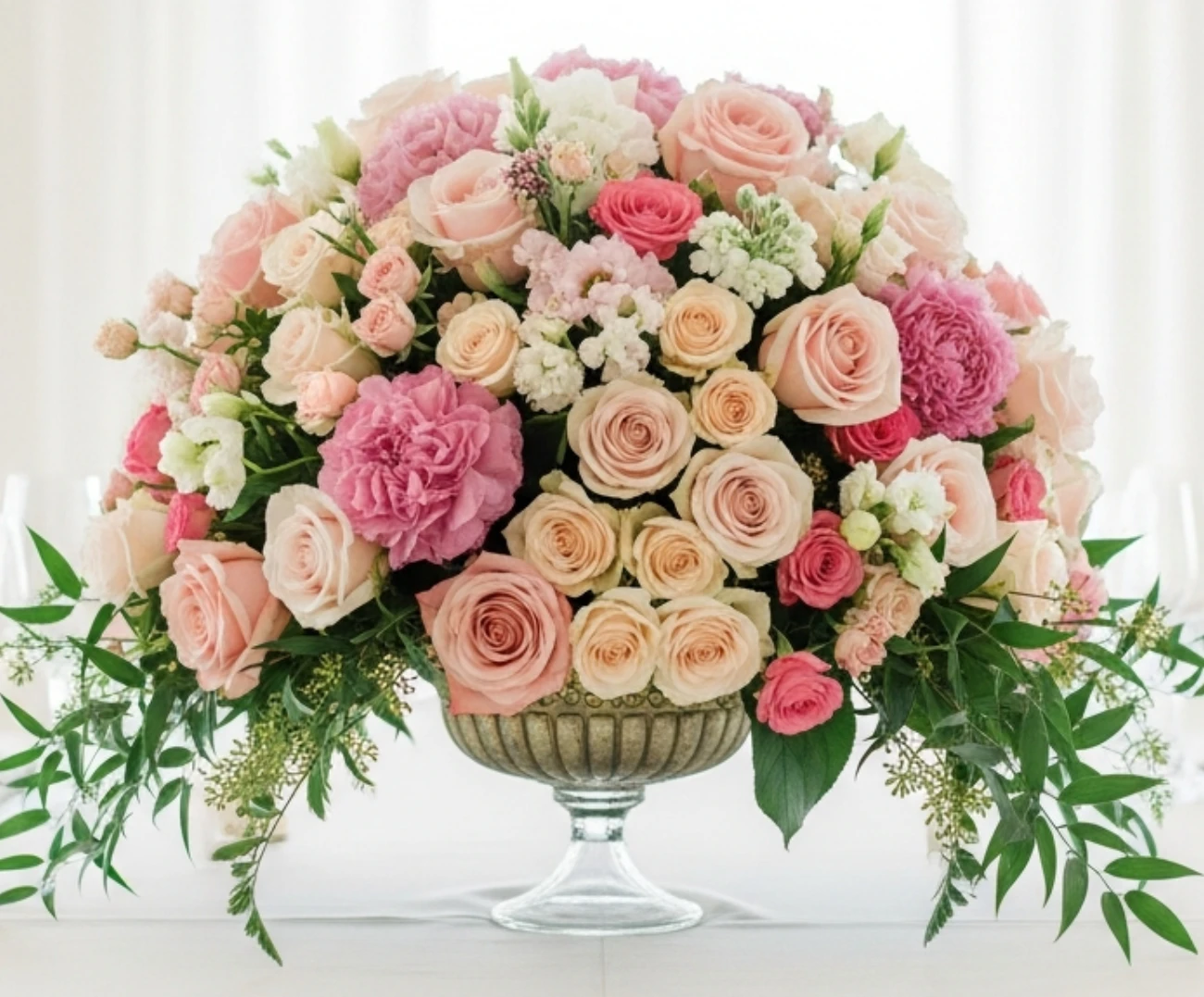
Flowers have a way of making any space feel more alive, more intentional, and more beautiful. A well arranged floral centerpiece does not just decorate a table, it sets the entire emotional tone of the room.
The wonderful thing about floral centerpieces is that there are genuinely no rules. A single stem in a beautiful bottle can be just as stunning as an overflowing compote of garden roses. It all comes down to intention and style.
These 32 ideas cover everything from minimal and modern to lush and dramatic.
Whether you are decorating for a wedding, a dinner party, a baby shower, or simply your own kitchen table on a Tuesday, there is something here that will inspire you.
Get ready to fall completely in love with flowers all over again.
1. Monochrome Floral Arrangements
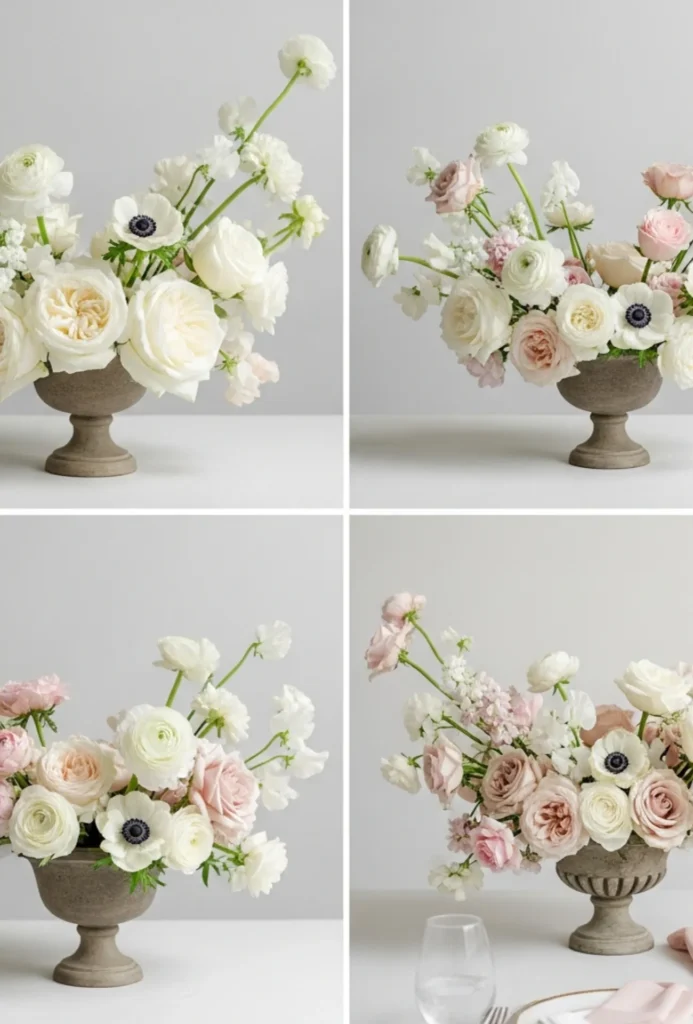
There is something quietly powerful about a floral arrangement built entirely within one color family. Monochrome florals feel considered, sophisticated, and deeply intentional in a way that multicolored arrangements sometimes do not.
Choose a single color and then explore every shade, tone, and texture within it. An all-white arrangement using garden roses, ranunculus, sweet peas, and white anemones has incredible depth and variation despite using no color at all.
An all blush arrangement mixing pale roses, peachy dahlias, and soft pink astilbe feels lush and romantic without ever feeling busy.
The secret to making monochrome arrangements work is variation in texture and form. When color is removed from the equation, the shape and surface quality of each bloom carries all the visual interest.
- Choose at least four to five different flower varieties within your chosen color
- Vary the scale of blooms from large focal flowers down to tiny filler pieces
- Add greenery or seed pods in the same color family to maintain the monochrome effect
- White and cream arrangements benefit from a mix of matte and slightly glossy bloom surfaces
2. Sculptural Flower Cloud Designs
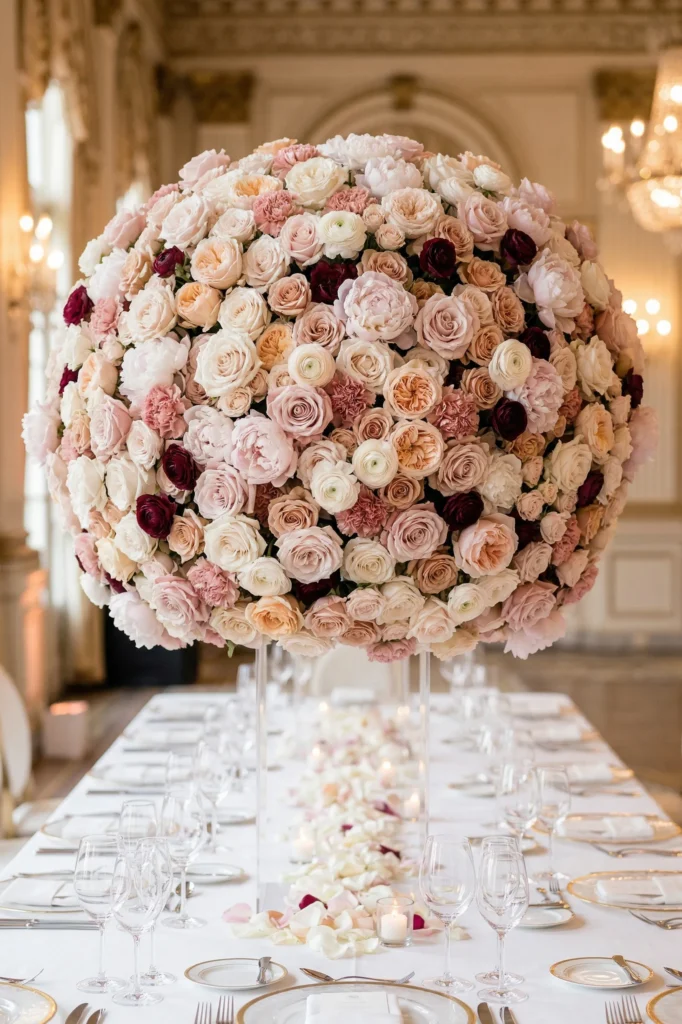
A flower cloud arrangement is one of the most dramatic and awe-inspiring floral centerpiece styles available.
The aim is density and volume, a mass of blooms so tightly packed and generously full that the arrangement resembles an actual cloud of flowers hovering over the table.
Achieve the effect by packing blooms of similar sizes very tightly into a round foam base or a wide, deep vessel.
Remove stems almost entirely and push flower heads in close together with almost no gaps between them. The surface should look continuous and flowing rather than individual flowers simply placed in a vase.
This style works best with roses, ranunculus, carnations, and garden peonies as these bloom types have the right scale and fullness to create the cloud effect convincingly.
| Flower Type | Cloud Effect Quality | Best Color for Clouds |
| Garden roses | Excellent, full and layered | Blush, white, deep red |
| Ranunculus | Outstanding, paper-thin layers | Peach, coral, soft yellow |
| Carnations | Very good, dense and even | White, dusty pink, burgundy |
| Peonies | Spectacular when fully open | Blush, hot pink, cream |
| Chrysanthemums | Solid and long-lasting | White, lavender, yellow |
3. Fruit & Floral Combinations
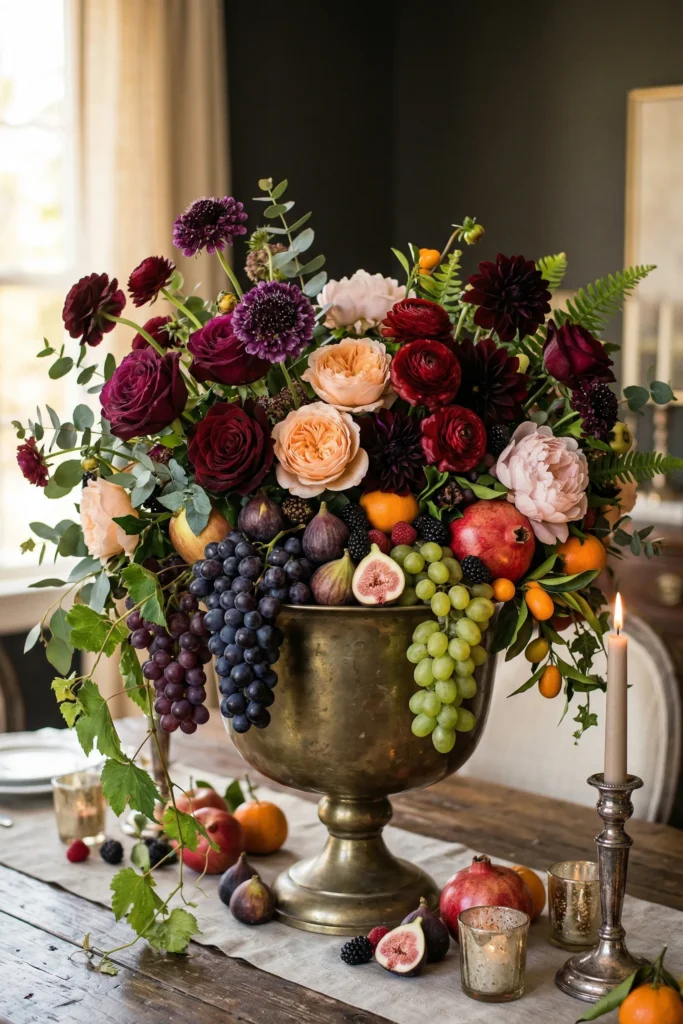
The combination of fresh fruit and flowers in a single centerpiece arrangement has roots in centuries of still-life painting and the reason it keeps coming back is simple. It is genuinely beautiful, abundant-looking, and uniquely sensory.
Tuck clusters of berries, small fruits, or sliced citrus directly into a floral arrangement alongside the blooms.
Trailing grape vines, small kumquats, fig halves, pomegranate seeds, and blackberries all work spectacularly. The colors and textures of fruit add a richness and earthiness to florals that greenery alone rarely achieves.
Choose fruit that echoes the color palette of your flowers. Deep burgundy roses paired with dark cherries and blackberries create something almost baroque in its richness. Blush peonies alongside sliced peaches and small apricots are pure summer abundance.
- Use fruit on the day of the event for freshest appearance and to avoid browning
- Secure smaller fruits like berries using floral wire or simply nestle them between stems
- Cut figs or citrus and tuck the cut face outward so the interior colors are visible
- Balance the proportion of fruit to flowers so neither overwhelms the other
4. Clustered Mini Arrangements
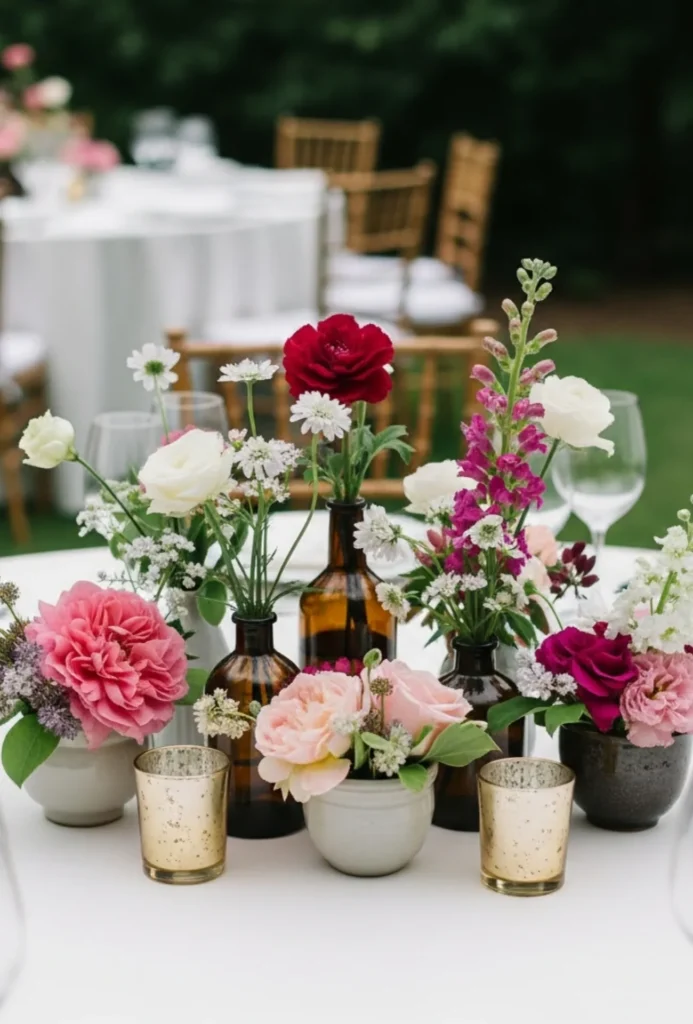
Rather than one large centerpiece, a cluster of several small arrangements grouped together creates a display that feels relaxed, abundant, and beautifully organic. The individual pieces can vary slightly while still reading as one cohesive centerpiece.
Use a mix of small vessels, short bud vases, tiny ceramic pots, glass bottles, and low bowls, and arrange a few stems in each one.
Push the vessels close together so the arrangements overlap and connect visually. The result looks like a gathered, overflowing garden scene rather than a single placed object.
The genius of this approach is its flexibility. You can add or remove individual vessels to fit different table sizes and you can swap out a single arrangement if one wilts before the others.
- Vary vessel heights so some arrangements sit lower and some reach slightly higher
- Let some stems lean and trail loosely rather than keeping every arrangement upright
- Use an odd number of vessels in each cluster for the most visually pleasing grouping
- Repeat one signature bloom across all the mini arrangements to unify the cluster
5. Mixed-Height Bud Vase Rows
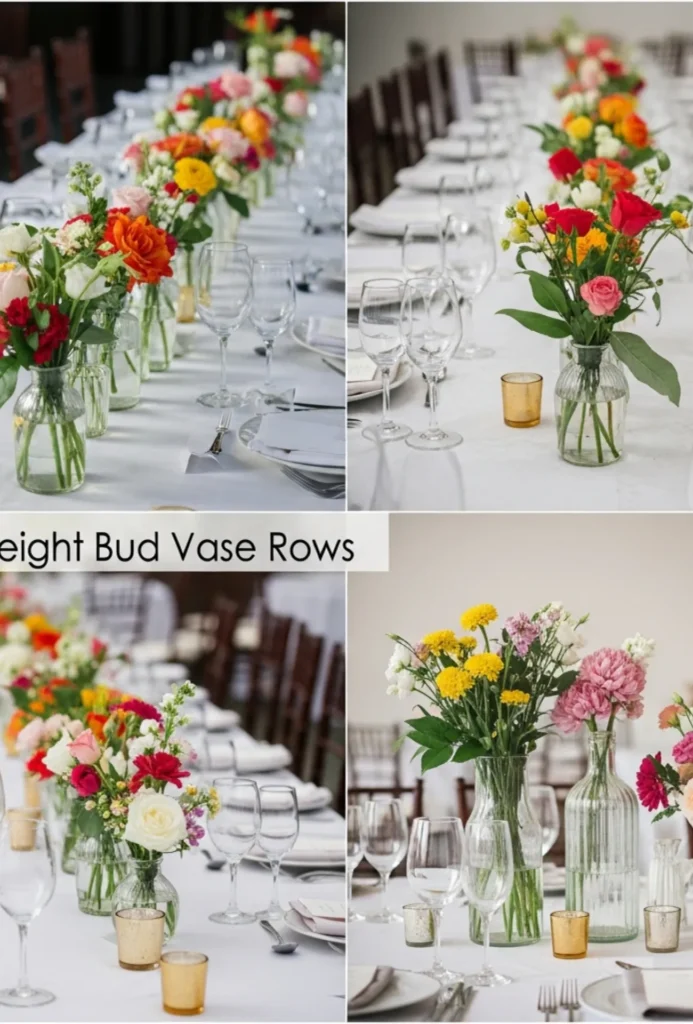
A row of bud vases in varying heights marching down the center of a long table is one of the most effortlessly elegant table centerpiece approaches there is. It works for dinner parties, wedding receptions, and any long table setting.
Choose vases in complementary shapes and heights, ranging from very short and wide to tall and narrow. Fill each with just one to three stems, keeping the arrangements intentionally sparse rather than full.
The beauty comes from the rhythm and repetition of the row rather than the fullness of individual arrangements.
Mix glass, ceramic, and perhaps one or two metal or stone vessels for textural variety. Keep the flower choices consistent across the row or let them transition gradually from one color family to another for a gentle ombre effect.
- Space vases slightly unevenly rather than perfectly equidistant for a natural feel
- Lay a loose greenery runner or scatter petals between the vases to connect them
- Mix empty decorative bottles into the row alongside filled vases for variation
- The row works beautifully with just foliage stems rather than flowers for a minimal look
6. Asymmetrical Garden Florals
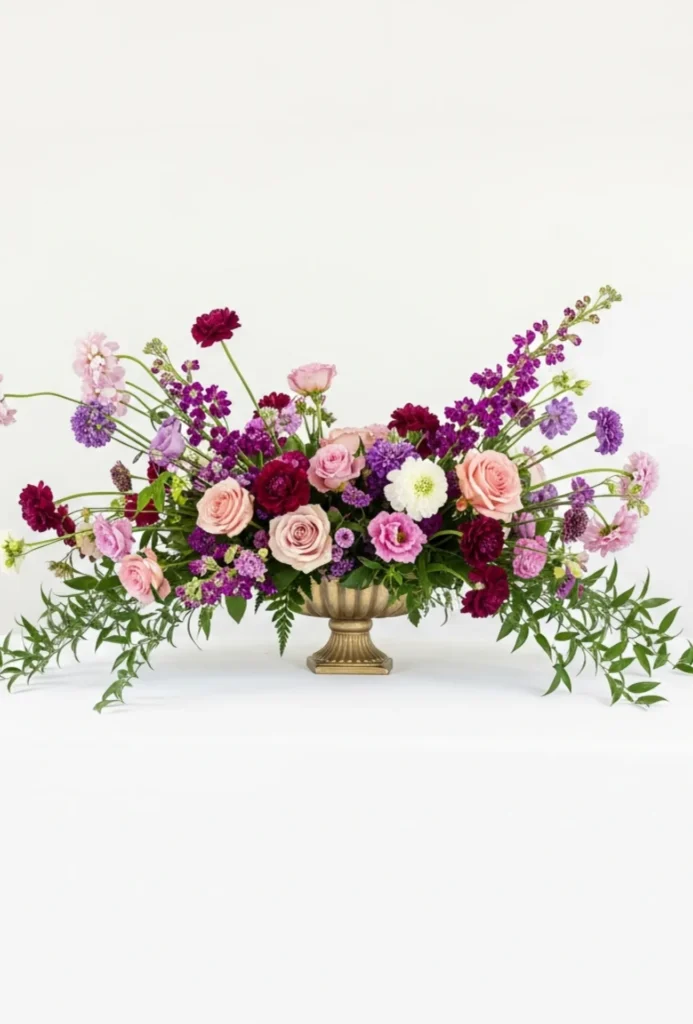
The perfectly symmetrical floral arrangement has its place, but there is a looseness and life to an asymmetrical garden-style arrangement that feels genuinely joyful and abundantly natural.
Build one side of the arrangement fuller and taller than the other, letting stems cascade and trail in one direction.
Include blooms at very different heights within the same arrangement and allow some stems to reach outward well beyond the vessel edge. The goal is controlled wildness, the feeling of flowers just cut from a garden and loosely gathered.
This style suits any vessel from a ceramic jug to a glass vase to an old tin pail. The more relaxed the vessel, the more the asymmetry feels intentional and artistic rather than simply unfinished.
- Establish your tallest stem first and build the rest of the arrangement around it
- Include at least one trailing stem that falls below the vessel rim
- Mix flower sizes dramatically from large focal blooms down to tiny filler details
- Step back frequently while arranging to check the overall silhouette from a distance
7. Floral & Draped Fabric Bases
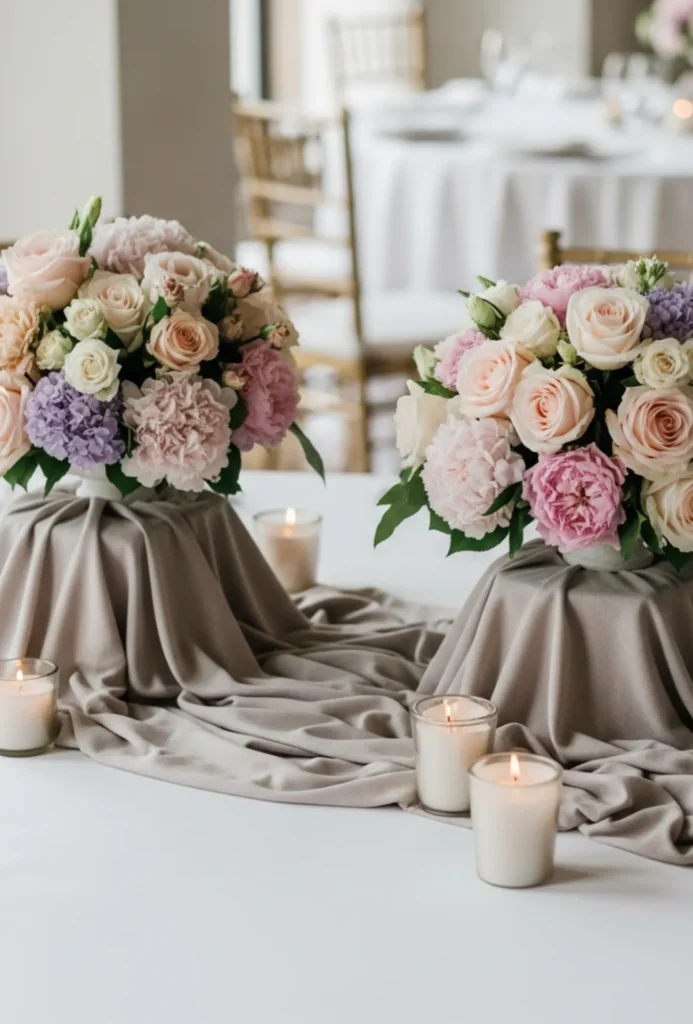
Adding soft draped fabric beneath or around a floral centerpiece creates an entirely different visual context for the blooms.
The fabric becomes part of the composition and elevates the whole display into something that feels styled and considered.
Choose a fabric that complements the flowers rather than competing with them.
Softly draped linen, silk, velvet, or tulle pooled loosely around the base of a floral arrangement adds texture, color, and softness to the table surface. The fabric can match the tablecloth or provide a deliberate contrast.
This technique is especially effective for low, wide arrangements where the table surface around the centerpiece is highly visible. The draped fabric fills and beautifies that surrounding space beautifully.
- Use unstructured, natural fabrics rather than stiff materials for the most elegant drape
- Let the fabric pool generously rather than pulling it taut around the arrangement
- Tuck flower heads or greenery sprigs into the fabric folds for a seamless transition
- Choose fabric in a tone just slightly off from the main flower color for subtle contrast
8. Floating Petals in Bowls
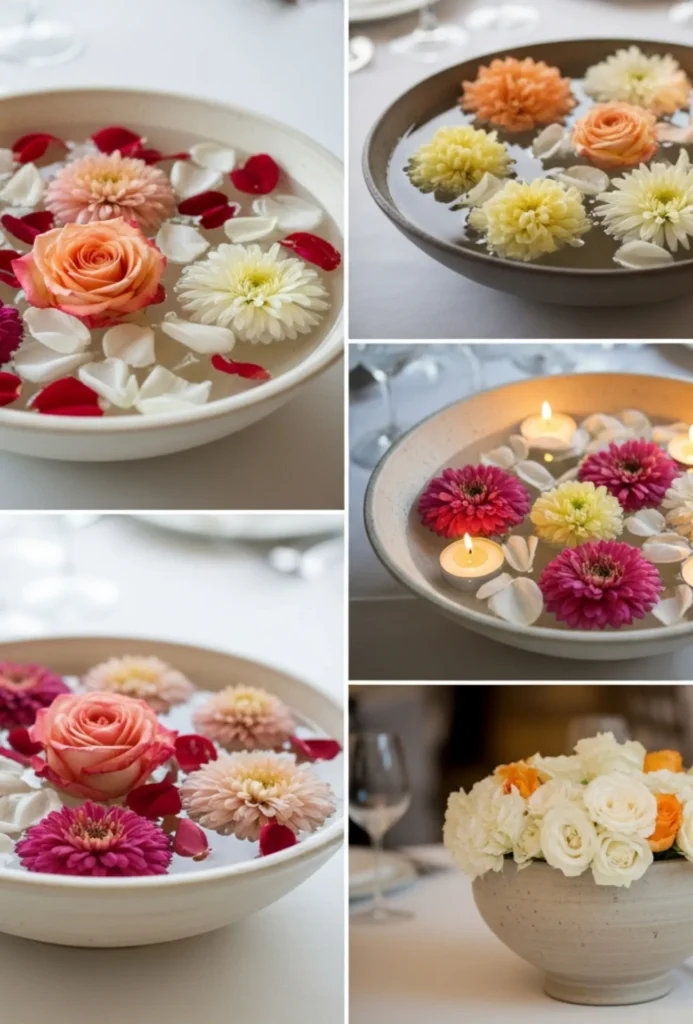
A wide, shallow bowl filled with water and floating flower petals or full flower heads is one of the most meditative and beautiful centerpiece formats.
It is serene, visually stunning, and works for everything from intimate dinners to large celebrations.
Fill a wide ceramic, glass, or stone bowl with clean water and float individual petals, full bloom heads, or a mix of both on the surface.
Add floating tea light candles between the flowers for an evening version that glows warmly. A few scattered petals on the table surface surrounding the bowl connects the centerpiece to the wider table.
Rose petals, gardenia heads, ranunculus, and small dahlias all float beautifully. Choose blooms with some natural structure so they hold their shape on the water surface rather than collapsing immediately.
| Bowl Style | Water Tint Option | Best Floating Flowers |
| Wide shallow ceramic | None, keep clear | Gardenias, ranunculus |
| Glass cylinder bowl | Pale blue or teal tint | White roses, anemones |
| Stone or concrete dish | None, keep natural | Dahlias, marigolds |
| Vintage enamel basin | Soft pink tint | Garden roses, sweet peas |
9. Potted Orchid Centerpieces
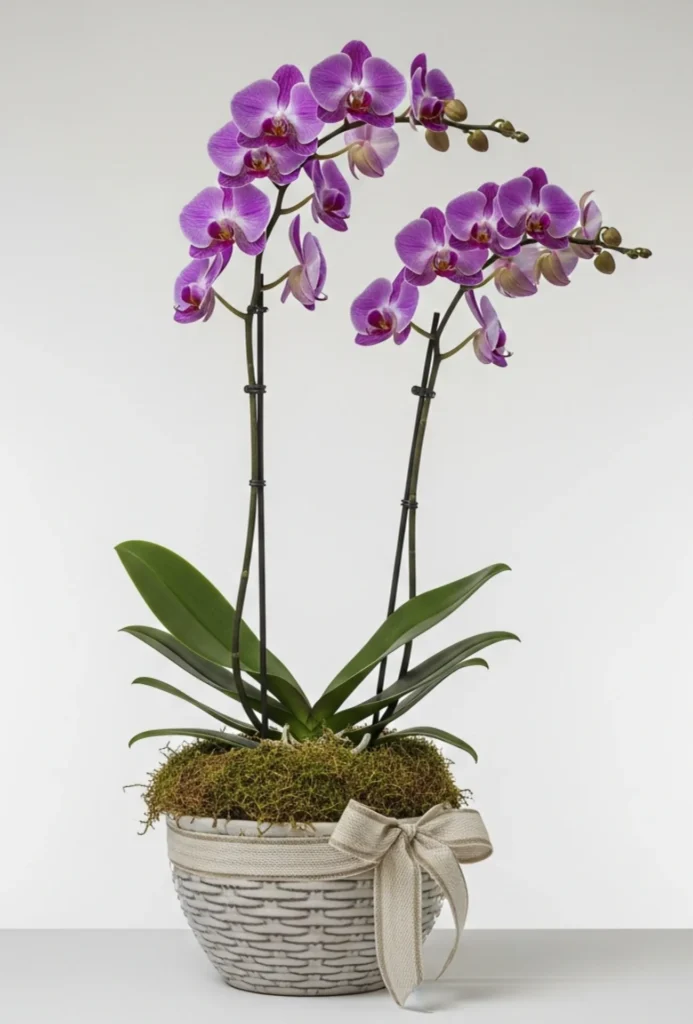
A potted orchid is one of those centerpieces that requires almost no arranging at all because the plant itself is already perfectly beautiful. The architectural elegance of an orchid stem in bloom is genuinely hard to improve upon.
Remove the plastic nursery pot and repot the orchid into a ceramic, terracotta, or woven basket planter that suits your event aesthetic.
Add a layer of moss over the potting medium to cover the soil neatly and give the display a finished, polished look. A ribbon or a simple strip of bark tied around the planter is all the decoration needed.
Group three orchids in complementary varieties together for a more substantial centerpiece or let a single perfect phalaenopsis stand alone as a statement piece. Either approach looks completely beautiful.
- Choose orchids with multiple buds not yet open so blooms last throughout and beyond the event
- White, blush, and deep purple orchids are the most versatile for event styling
- Place on a small riser or decorative tray to add height and define the centerpiece space
- Mist the leaves lightly before the event for a fresh, just-watered appearance
10. Dried & Fresh Flower Mixes
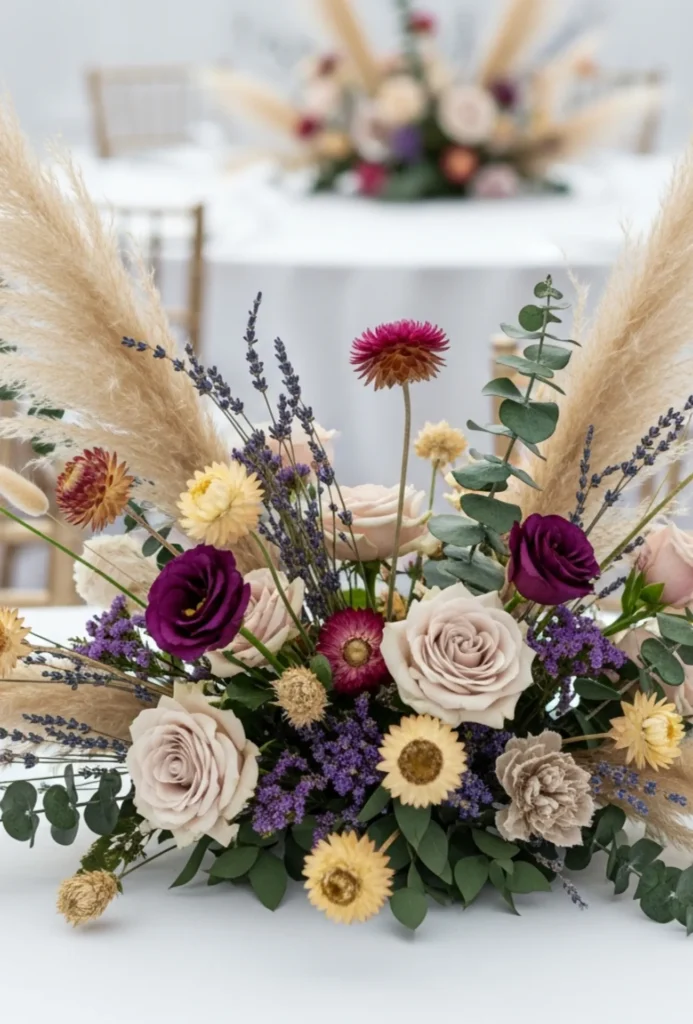
Combining dried and fresh flowers in a single arrangement creates something with wonderful tension and contrast.
The crisp, living quality of fresh blooms set against the muted, papery texture of dried botanicals produces an arrangement that feels both romantic and slightly wild.
Use dried pampas grass, dried lavender, preserved eucalyptus, dried strawflowers, or dried seed heads as the structural base of the arrangement.
Add fresh blooms in complementary colors as the focal points. The dried elements provide volume and texture while the fresh flowers bring vibrancy and life.
This combination also means the arrangement has an extended life. As the fresh flowers eventually fade, the dried elements remain and the display simply evolves rather than collapsing entirely.
- Condition fresh stems well before adding them to arrangements with dried elements
- Choose dried botanicals in tones that naturally complement rather than clash with fresh flower colors
- Dried grasses and seed heads add beautiful movement and height to the arrangement
- The arrangement improves photographically as it ages and the fresh elements begin to dry
11. Tropical Bold Leaf Florals
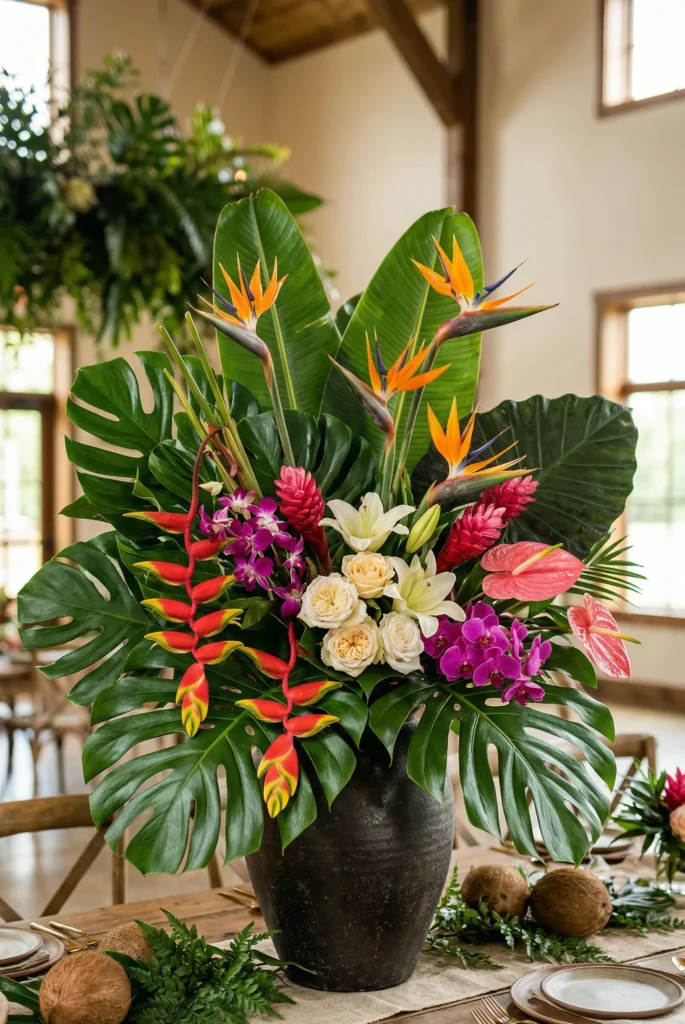
Tropical arrangements have an energy and confidence that is entirely their own. Large, bold leaves combined with architectural tropical flowers create centerpieces that feel lush, dramatic, and full of life.
Build the arrangement using large structural leaves as the foundation. Bird of paradise leaves, monstera, banana leaf, elephant ear, and philodendron all make spectacular backdrops for tropical blooms.
Add heliconia, anthurium, tropical ginger, or orchid sprays as the focal flowers and the arrangement practically styles itself.
The scale of tropical arrangements means they work best in larger venues or as statement pieces at long tables. A single tropical arrangement can fill a space that would require three or four conventional floral arrangements.
- Keep the vessel large, heavy, and stable to support the weight of tropical stems
- Wipe large leaves with a damp cloth before use to remove dust and enhance their gloss
- Tropical arrangements prefer warm venues and will last longer away from air conditioning drafts
- Add a few conventional blooms like roses or lilies alongside tropical elements for softness
12. Foam-Free Loose Arrangements
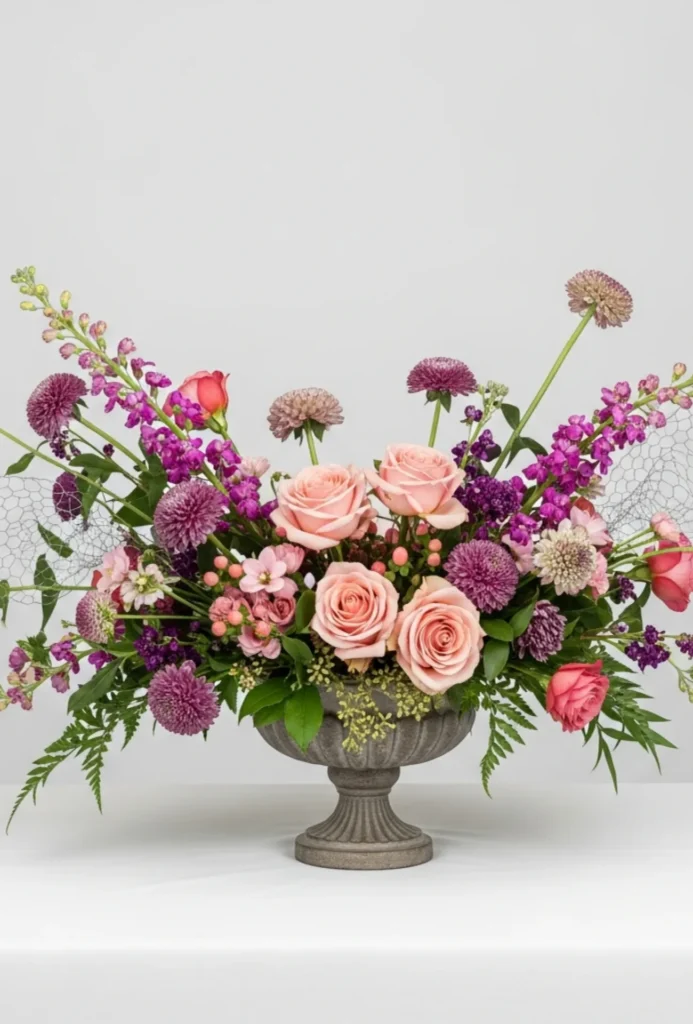
The movement away from floral foam toward more sustainable arranging methods has genuinely improved floral design.
Foam-free arrangements have a natural looseness and movement that foam-based arrangements often lack.
Use chicken wire, a flower frog, or simply the crosshatch technique of tape across the vase opening to support stems without foam.
The slightly less controlled nature of this method produces arrangements that look gathered and natural rather than structured and stiff. Stems find their own angles and the arrangement breathes.
Loose arrangements suit relaxed party styles, garden events, and any occasion where the feel is warm and natural rather than formal and precise.
- A simple crosshatch of clear tape across a vase opening provides excellent stem support
- Add heavier stems first as they provide a framework that supports lighter stems added after
- Embrace stems that lean at unexpected angles rather than correcting everything upright
- Loose arrangements drink more water so check and refill vessels more frequently
13. Low Compote Bowl Designs
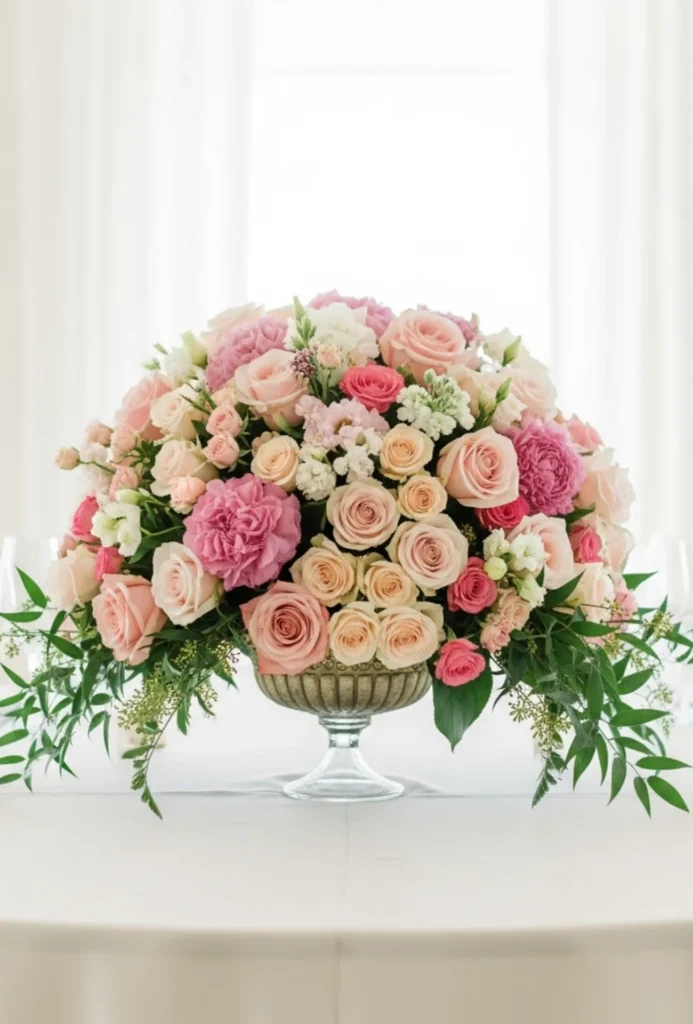
A low, wide compote bowl filled with a lush, dome-shaped floral arrangement is one of the most classic and timeless centerpiece formats. It sits low enough for guests to see across the table while still being visually full and generous.
Fill the compote with a generous dome of tightly arranged blooms, working from the outside edge inward and upward. Include trailing pieces that spill slightly over the rim of the bowl for a relaxed, overflowing garden feeling.
The low profile makes this arrangement perfect for dinner tables where guest conversation should not be interrupted by tall centerpieces.
Choose a compote in a material that suits your event. Silver for formal occasions, terracotta for rustic warmth, alabaster or marble for contemporary elegance, and clear glass for versatility.
- Keep the arrangement dome slightly higher in the center for the most flattering silhouette
- Include a few pieces that extend well beyond the bowl rim for a fuller, more generous look
- Fill the compote with water-soaked foam or a water-filled inner vessel for fresh stem support
- Compote arrangements look spectacular when duplicated down the length of a long table
14. Color-Block Floral Styles
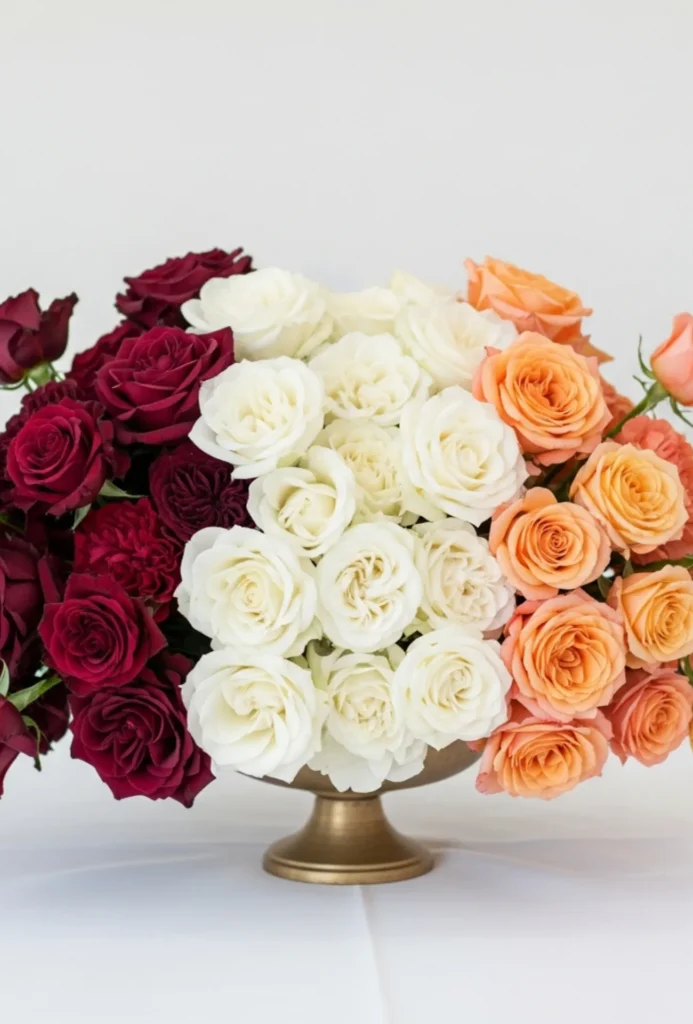
Color-blocking in floral arrangements means deliberately placing distinct zones of different colors within a single arrangement rather than blending and mixing everything together. The effect is bold, graphic, and visually striking.
Create defined sections within the arrangement where one color dominates completely before transitioning to the next.
Deep burgundy on one side, pure white in the middle, and warm peach on the other creates a color-block arrangement that reads almost like a painting.
The zones can be hard-edged and precise or soft and slightly blended depending on the intended style.
This approach suits modern, design-conscious party aesthetics and any event where a bold visual statement is the goal.
- Plan your color zones before beginning the arrangement so transitions happen deliberately
- Use flowers of similar scale and form across the zones so color rather than texture dominates
- Three color blocks work better than two or four for the most visually balanced result
- Color-block arrangements photograph particularly beautifully from directly above
15. Wildflower Inspired Centerpieces
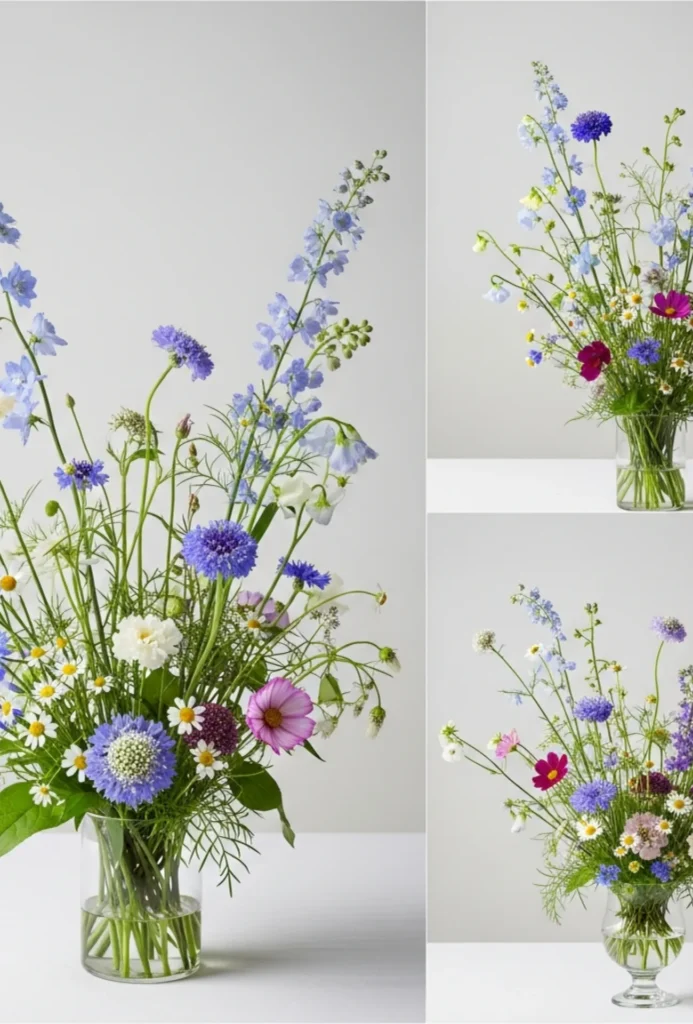
A wildflower inspired arrangement captures the feeling of a casual bunch gathered from a summer meadow.
The beauty is in the apparent randomness of it, the mix of scales, textures, and colors that looks effortless even though it requires genuine skill to achieve.
Mix fine, delicate flowers like sweet peas, cornflowers, scabiosa, and larkspur with small daisies, cosmos, and grasses.
Let different stem heights coexist without forcing everything to a uniform level. Include stems with interesting seed heads or small buds alongside fully open blooms.
Place in a relaxed vessel like a ceramic jug, an old glass bottle, or a simple tin to complete the casual, gathered-from-the-garden feel. The arrangement should look like someone walked outside with scissors and came back in five minutes later.
| Wildflower Variety | Season | Color Range |
| Sweet peas | Spring, early summer | Pink, mauve, white, coral |
| Cornflowers | Summer | Blue, purple, white, pink |
| Cosmos | Summer, autumn | Pink, magenta, white, orange |
| Scabiosa | Summer | Lavender, white, deep purple |
| Larkspur | Summer | Blue, purple, pink, white |
16. Single Variety Minimalist Blooms
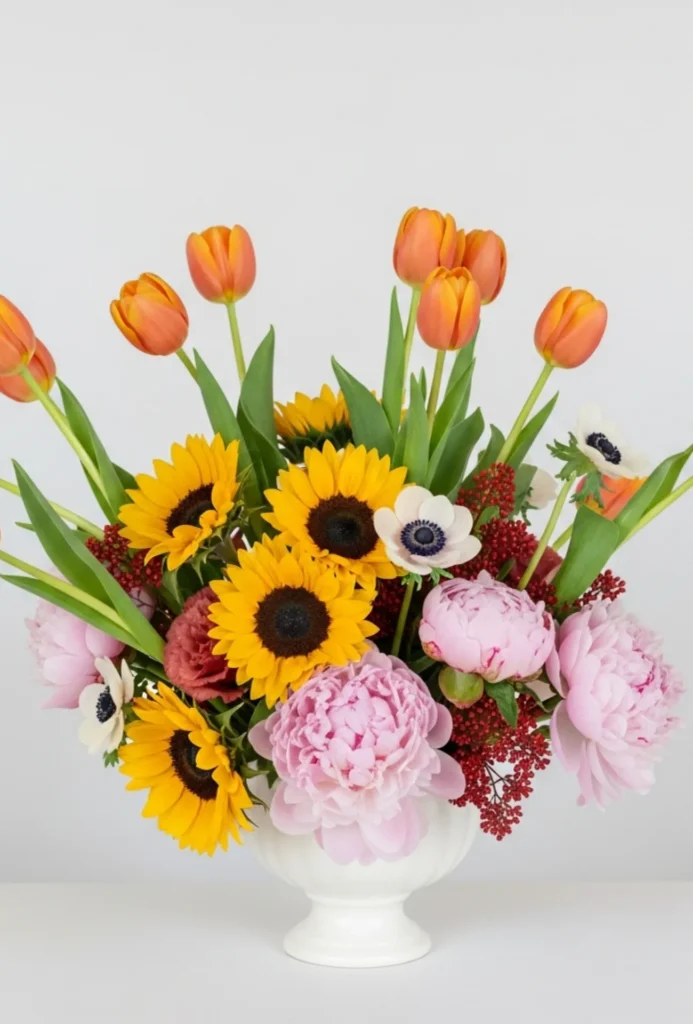
Sometimes the most powerful floral statement is the most restrained one. A generous bunch of a single flower variety, all the same bloom, all roughly the same height, placed in one simple vase is quietly breathtaking.
All-tulip arrangements in spring, all-sunflower arrangements in summer, all-peony arrangements in early summer, and all-anemone arrangements in autumn all have a graphic, confident quality that complex mixed arrangements sometimes lack. The repetition of one beautiful form creates rhythm and visual calm.
Choose the vase carefully because it becomes equally important when the arrangement is this minimal. A perfect all-white ranunculus arrangement in a matte black ceramic vessel looks genuinely extraordinary.
- Cut stems to a consistent length for a clean, architectural silhouette
- Allow for some natural variation in bloom openness so not all flowers are at the same stage
- Remove all foliage from stems for the most minimal and refined result
- A very generous number of stems makes single-variety arrangements feel luxurious rather than sparse
17. Floral & Moss Arrangements
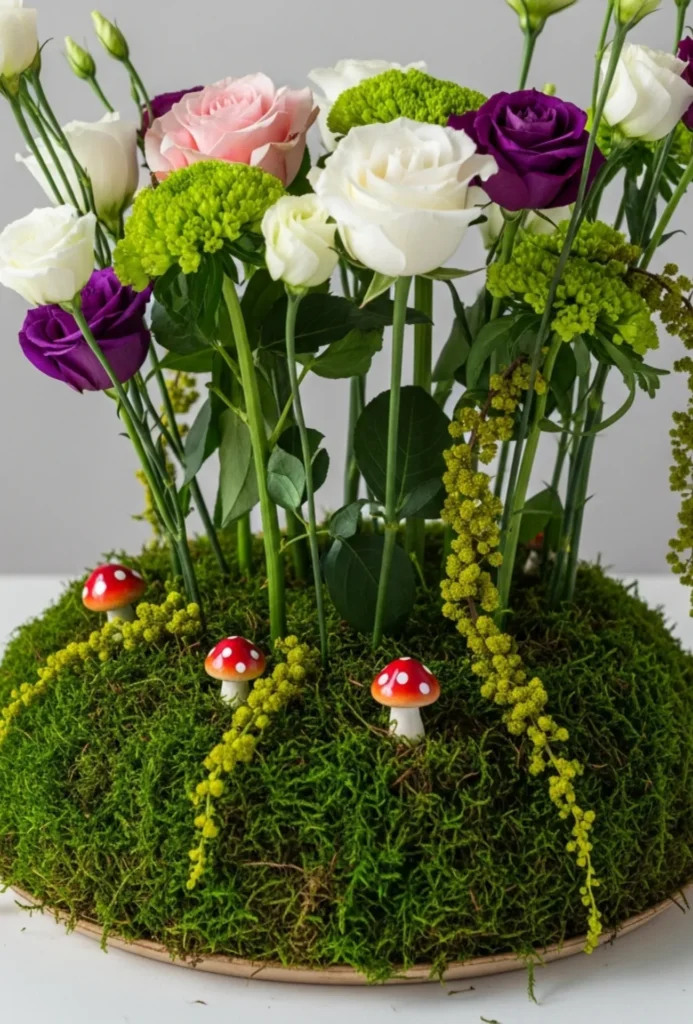
Incorporating fresh or preserved moss into a floral arrangement adds a living, forest-floor quality that no other material quite replicates.
Moss brings deep green color, incredible texture, and an earthy freshness that makes florals feel rooted and wild.
Build a base of sheet moss or cushion moss around the inner edge of a wide vessel. Nestle flower stems directly into the moss layer so blooms appear to be growing from the ground rather than arranged in water.
Add small mushroom picks, trailing ivy, ferns, and forest floor plants to deepen the woodland quality.
This style suits woodland weddings, autumn celebrations, earthy dinner parties, and any event where a natural, organic aesthetic is the intention.
- Mist moss lightly before and during the event to keep it looking fresh and vivid
- Use preserved sheet moss for low-maintenance arrangements that do not require water
- Tuck tea light candles into moss pockets around the base of the floral stems
- Combine several moss-based arrangements along a table runner for a living forest table
18. Hanging Floral Accents
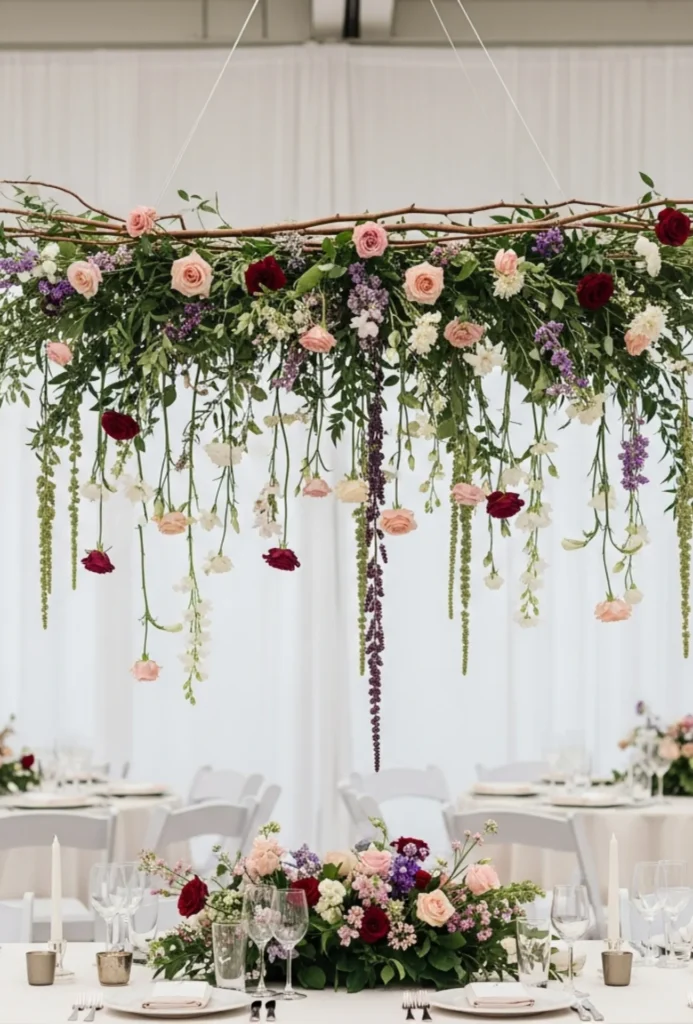
Flowers that hang above the table rather than sitting on it create a completely different kind of magic. Hanging floral installations transform the vertical space above the table into part of the centerpiece and the effect is nothing short of spectacular.
Suspend a wooden hoop, a branch, or a floral frame above the table and hang flower clusters, single stems, or loose garlands downward from it.
The flowers drift above the table at eye level when seated, which creates an enveloping, immersive quality that a table-level centerpiece simply cannot achieve.
This style is particularly popular for wedding head tables and intimate dinner parties where the suspended element creates a sense of occasion and theater.
- Ensure any hanging element is secured safely and well above head level
- Hang flowers at varying lengths from the suspension point for movement and depth
- Use hardy flower varieties for hanging as they experience more stem stress than arranged flowers
- Add small trailing greenery vines alongside hanging blooms for a lush, garden feel
19. Floral Table Runners
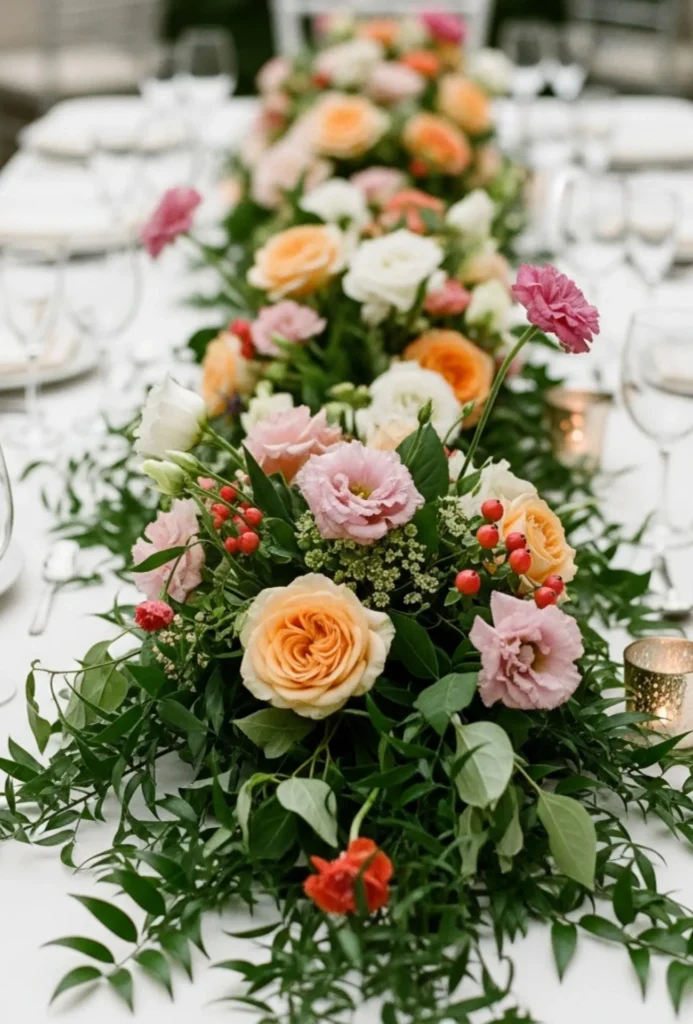
A floral runner laid down the full length of a table rather than a single centerpiece point is one of the most generous and romantic ways to decorate a party table.
It covers the entire center of the table in a continuous river of blooms and greenery.
Lay a base of greenery stems directly on the table surface and layer flower heads and blooms throughout the length of the runner.
Include varying heights within the runner by propping some stems slightly higher than others. Tuck in small candle holders at intervals for an evening table.
A loose, organic runner looks more beautiful than a tight, rigid one. Let it be slightly uneven in places, with some areas denser than others. That variation is what makes it feel alive rather than manufactured.
- Lay a thin plastic sheet under the runner to protect the table surface from moisture
- Build the runner from the center outward toward each end for the most balanced result
- Include trailing elements that extend slightly over the table edge for a generous, romantic feel
- Replenish any wilting sections during long events by tucking in fresh flower heads
20. Textured Vase Florals
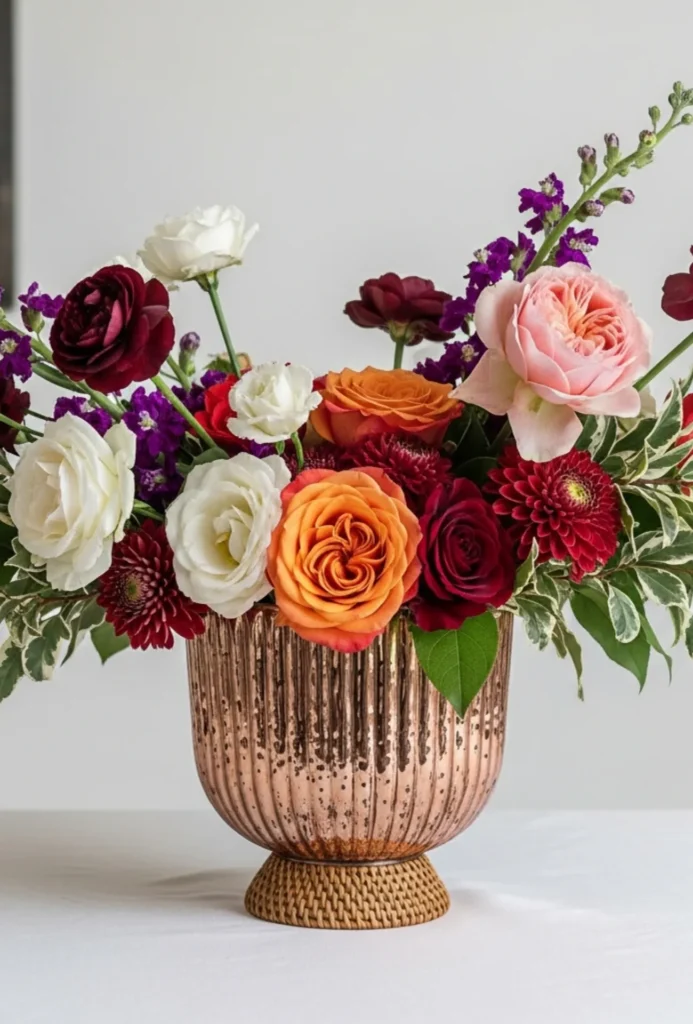
The vessel carrying a floral arrangement is as much a part of the centerpiece as the flowers themselves. When the vase has extraordinary texture, the combination of vase and bloom creates something that feels complete and fully considered.
Choose vessels with strong surface interest: ribbed glass, hammered copper, carved ceramic, rough-hewn stone, woven rattan, or burnished bronze.
Place the blooms in a way that allows the vase to remain visible rather than being completely obscured by foliage. The interplay between the floral softness and the vessel’s hard texture creates genuine visual tension.
A simple arrangement in a remarkable vessel will always outperform a complex arrangement in a plain one. The vase deserves as much consideration as the flowers.
- Limit foliage so the texture of the vessel remains visible and part of the composition
- Choose flower types that contrast with the vase texture: soft silky petals in a rough stone vessel
- Ribbed or grooved vases photograph with incredible depth and dimension
- Collect interesting vessels throughout the year rather than scrambling for them pre-party
21. Pastel Ombré Arrangements
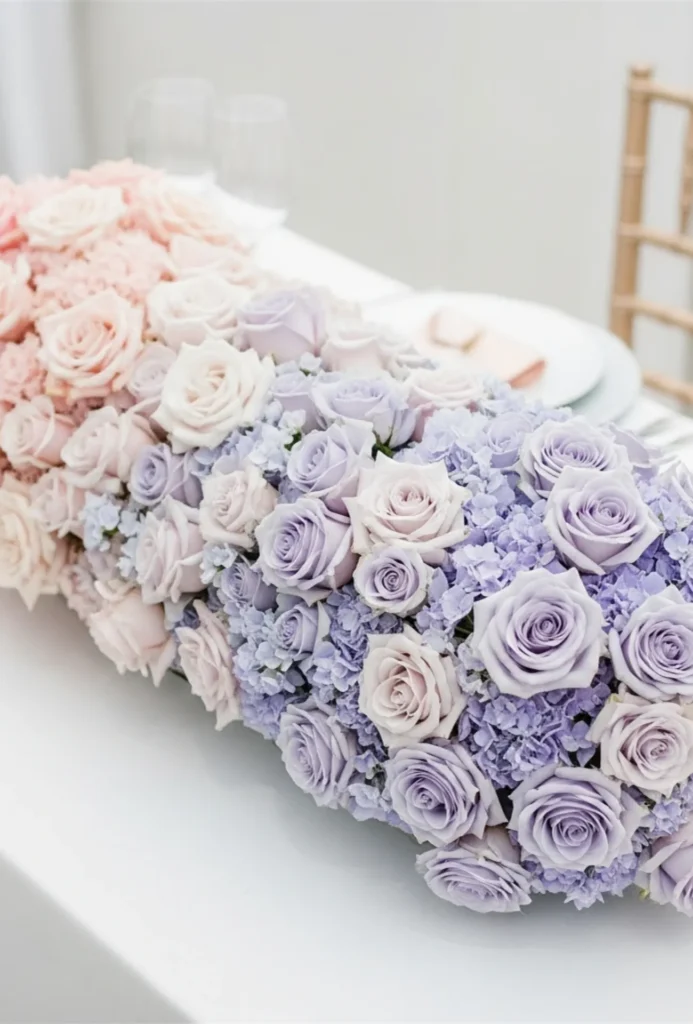
A pastel ombré arrangement transitions gently from one soft color to another through the body of the arrangement, creating a gradient effect that is dreamy, painterly, and incredibly beautiful.
Start with the palest tone, perhaps the softest blush or barely-there lavender, at one side or the top of the arrangement and work progressively toward a slightly deeper shade of the same hue at the other side or the base.
The transition should be gradual and gentle, with flowers of intermediate shades bridging the gap.
This works especially well for arrangements transitioning from white through cream through blush to soft pink, or from pale sky blue through lilac to soft lavender. The effect is most powerful when all the flowers share a similar petal texture.
- Plan the ombré gradient before beginning so the transition happens with intention
- Use flowers at different stages of bloom opening to create subtle variations within each color zone
- Photograph ombré arrangements from slightly above for the most visible gradient effect
- White and cream flowers at the center of the arrangement make the colors read brighter around them
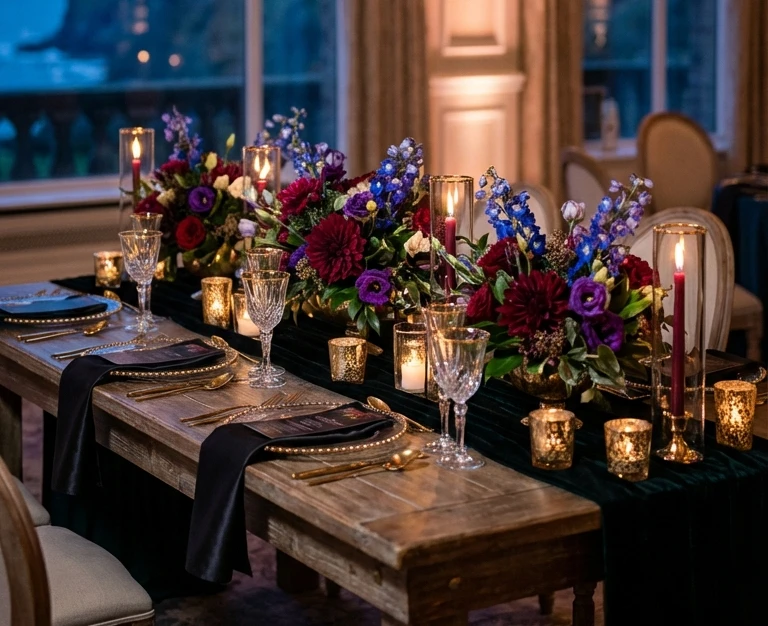
22. Jewel Tone Dramatic Florals
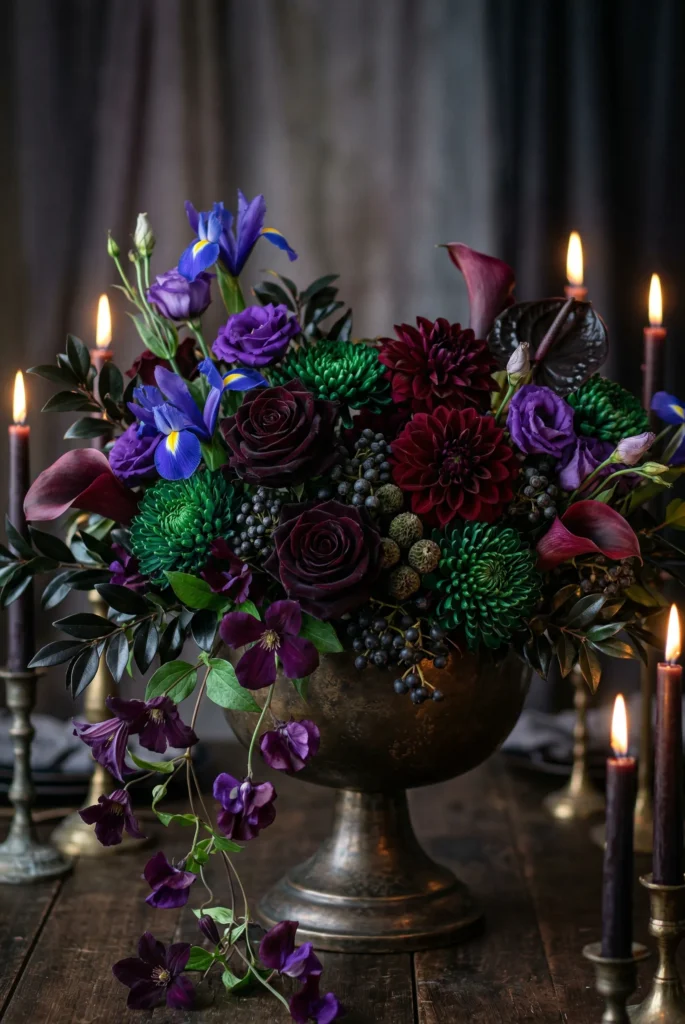
When the goal is drama and impact, jewel-tone florals deliver in a way that no other palette can match.
Deep emerald, rich sapphire, velvet burgundy, and jewel-bright amethyst combined in a lush arrangement feel almost theatrical in the best possible way.
Choose flowers in the deepest, most saturated versions of their colors. Dark ‘Black Baccara’ roses, deep burgundy dahlias, purple lisianthus, cobalt blue irises, and emerald green chrysanthemums all contribute to the jewel-tone effect.
Pair with deep, glossy foliage in near-black green tones rather than bright green leaves.
Use a vessel in a complementary dark tone, deep teal, black, dark bronze, or charcoal, so the arrangement feels fully immersed in its own dramatic color world rather than sitting in a contrasting vase.
- Add deep aubergine sweet peas or dark clematis vines for trails of saturated color
- Include anthuriums or calla lilies in deep wine or near-black tones for architectural drama
- Use dark berries and pods alongside the flowers for additional texture and depth
- Jewel-tone arrangements look their most dramatic in candlelit settings
23. Floral & Candle Layering
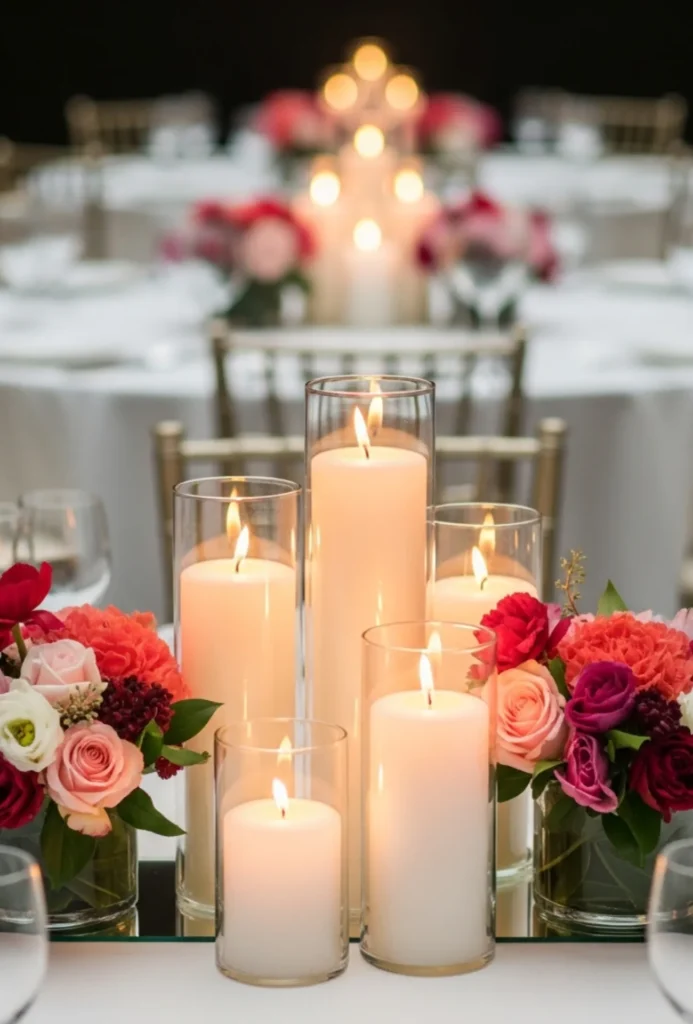
Flowers and candlelight are the most natural partners in table decoration. Layering them intentionally within a single centerpiece concept rather than simply placing them near each other creates something with genuine warmth and atmosphere.
Arrange pillar candles of varying heights among flower clusters so that blooms and flames coexist at different levels within the same display.
Low flower arrangements surround tall candles, or flower heads are tucked in around the base of grouped candle holders. The candlelight illuminates the petals from close range and the effect is intimate and beautiful.
Always ensure flowers are positioned well away from open flames. Use battery-operated candles if working with delicate blooms that sit close to the light source.
| Candle Type | Flower Pairing | Mood Created |
| Tall tapers in holders | Low surrounding florals | Formal, elegant, romantic |
| Pillar candles | Medium height blooms | Warm, classic, celebratory |
| Votives in glass | Loose scattered petals | Intimate, soft, delicate |
| Wide column candles | Lush full arrangements | Luxurious, dramatic, rich |
24. Seasonal Garden Style Blooms
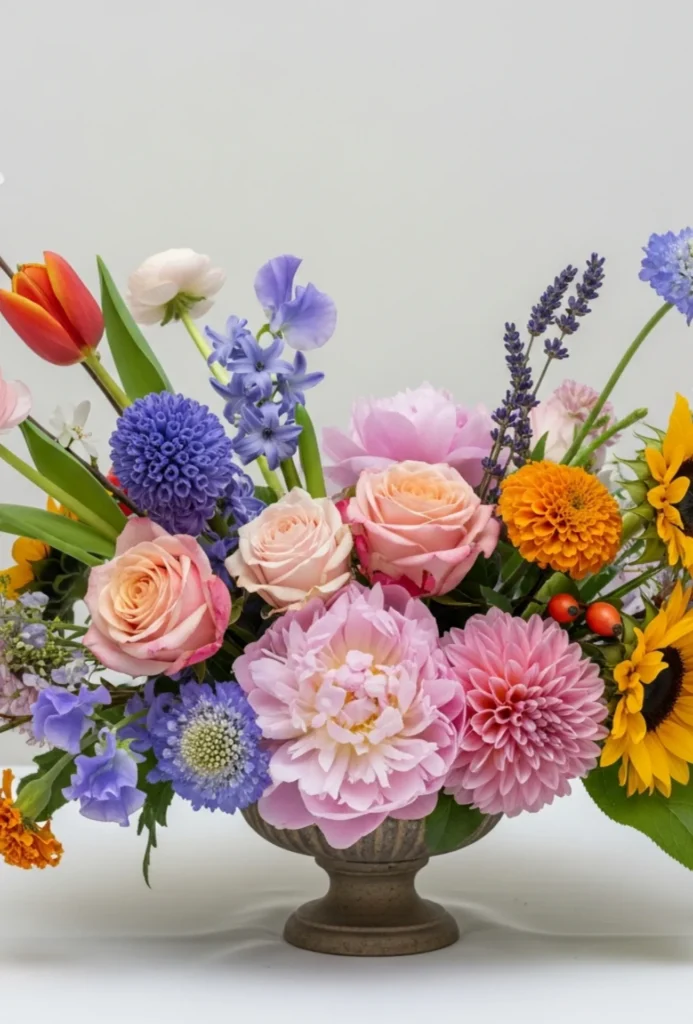
A seasonal garden-style arrangement uses only what is naturally available and at its peak in the current season.
The result always feels fresh, appropriate, and genuinely connected to the time of year in a way that out-of-season imported flowers cannot replicate.
Spring arrangements lean on tulips, ranunculus, sweet peas, hyacinths, and blossom branches. Summer brings roses, peonies, dahlias, lavender, and sunflowers.
Autumn centers on chrysanthemums, marigolds, scabiosa, and rose hips. Winter calls for hellebores, amaryllis, evergreen branches, and berried stems.
Working with seasonal blooms also tends to be significantly more budget-friendly than sourcing specialty or imported flowers, and the arrangements carry a sense of honest beauty that is hard to manufacture artificially.
- Visit a local flower market for the most current seasonal availability in your region
- Seasonal arrangements benefit from including the foliage and branches of the season
- Embrace whatever is most abundant in the season rather than searching for rarities
- Seasonal arrangements age beautifully and shift in appearance over the course of a multi-day event
25. Florals with Dried Grasses
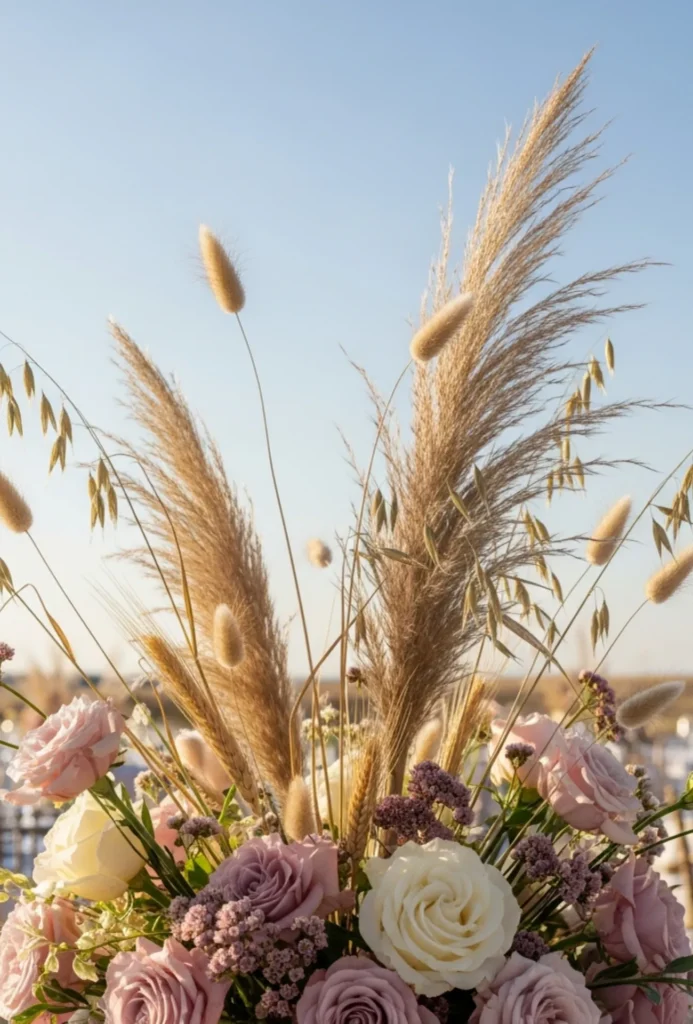
The combination of soft flowering blooms with the linear, movement-filled quality of dried grasses creates arrangements with incredible depth and a sense of wild, open landscape.
Use dried bunny tail grass, dried wheat, wild oat grass, feather reed grass, or dried miscanthus as the airy, reaching elements in the arrangement.
Add fresh or dried blooms at a lower level, allowing the grasses to rise above and beyond the flowers. The grasses create a sense of sky and horizon above the blooms.
This style suits bohemian weddings, autumn celebrations, country house parties, and any event where a relaxed, natural aesthetic with genuine outdoor character is the goal.
- Use grasses of notably different heights to create layers within the upper reaches of the arrangement
- Dried grasses shed, so arrange in the final location and handle minimally after completion
- Soft neutrals and warm ambers in both grasses and blooms create the most cohesive palette
- Spray dried grasses very lightly with hairspray to reduce shedding during the event
26. Ikebana Style Minimal Designs
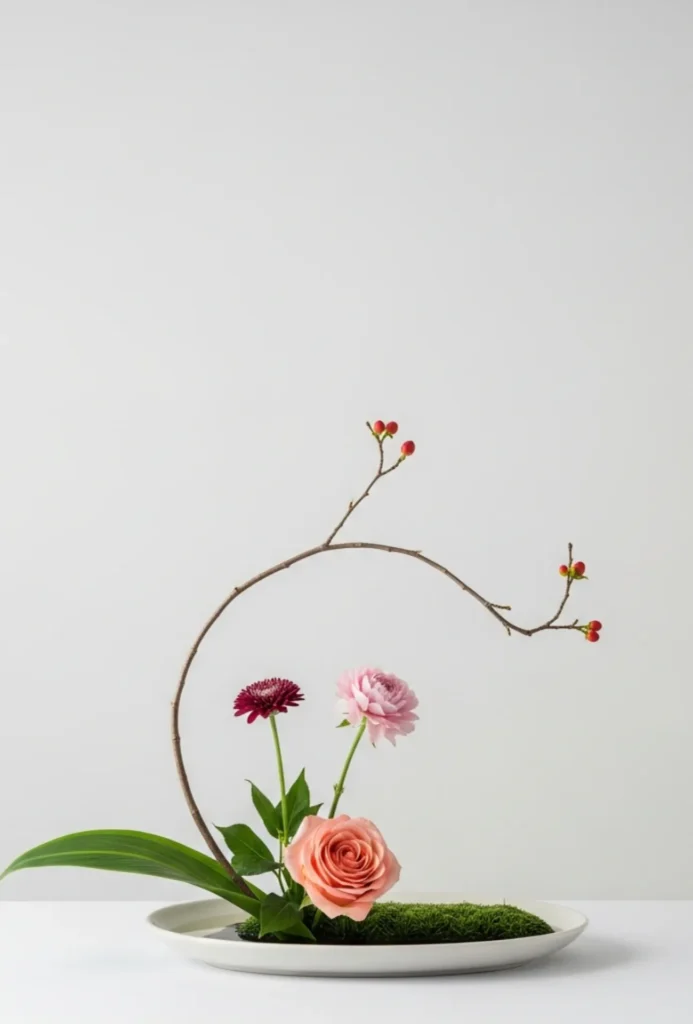
Ikebana is the Japanese art of flower arranging and its influence on modern minimal floral centerpieces is profound.
The emphasis on negative space, asymmetry, and the beauty of individual stems produces arrangements that feel meditative, precise, and deeply elegant.
Choose just two or three stems and place them with extreme intention. A single curved branch, one open bloom, and a few leaves placed asymmetrically in a shallow kenzan holder creates a composition that has the quality of a drawing or a sculpture.
The empty space around the stems is considered as important as the stems themselves.
Ikebana-inspired arrangements reward stillness and looking. They are the opposite of abundance and their restraint is their entire strength.
- Use a kenzan frog or floral pin holder as a base for precise stem placement
- Curve stems gently by hand or use naturally arching branches for organic line work
- Place the arrangement off-center within its vessel rather than in the middle
- Study the natural growth direction of each stem and respect rather than fight it
27. Citrus & Floral Vases
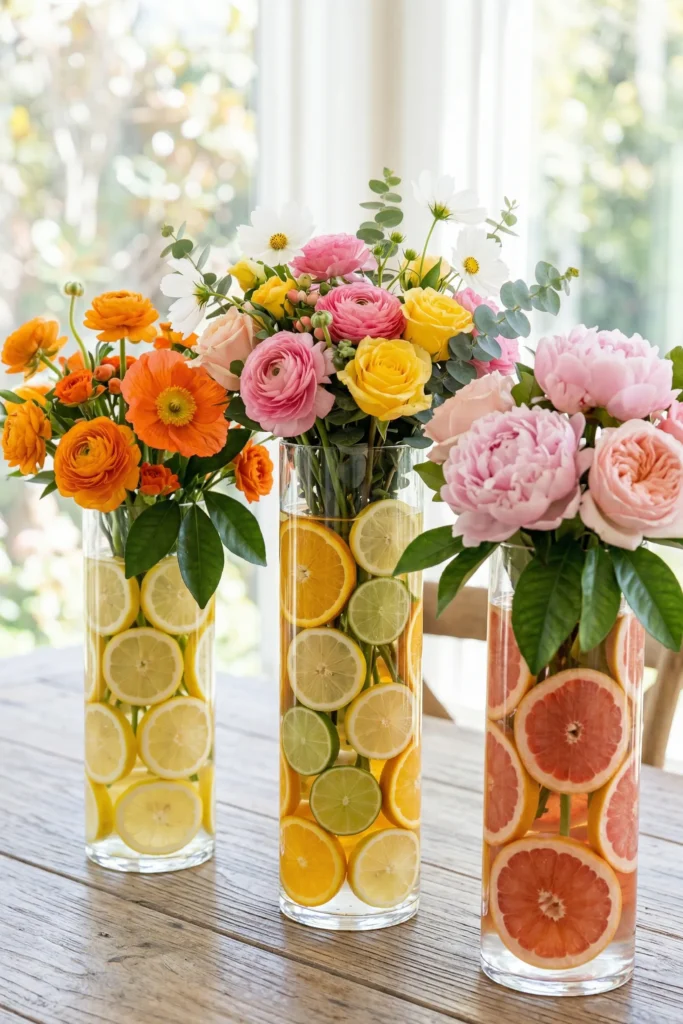
The combination of sliced citrus layered inside a clear glass vase with flower stems arranged above creates one of the freshest, most visually vibrant centerpieces on this entire list. The colors of the citrus through the glass are as beautiful as any flower.
Layer sliced lemons, oranges, limes, or grapefruits along the inner walls of a tall glass cylinder vase. Fill with water and arrange flower stems in the center. The citrus acts as both decoration and a natural method for keeping stems in position.
The color combinations of fruit and flower together are endlessly beautiful.
Choose flowers whose colors naturally complement the citrus you are using. Orange flowers with lemon slices, pink blooms with grapefruit rounds, white flowers with lime slices. Each combination feels fresh, clean, and full of energy.
- Use room temperature fruit for easier slicing and more pliable placement against the glass
- Alternate citrus types within the same vase for a more varied and colorful layer effect
- Add a few whole leaves from the citrus tree if available for an authentic botanical quality
- Replace the water and citrus if the arrangement needs to last more than two days
28. Boho Pampas & Blooms
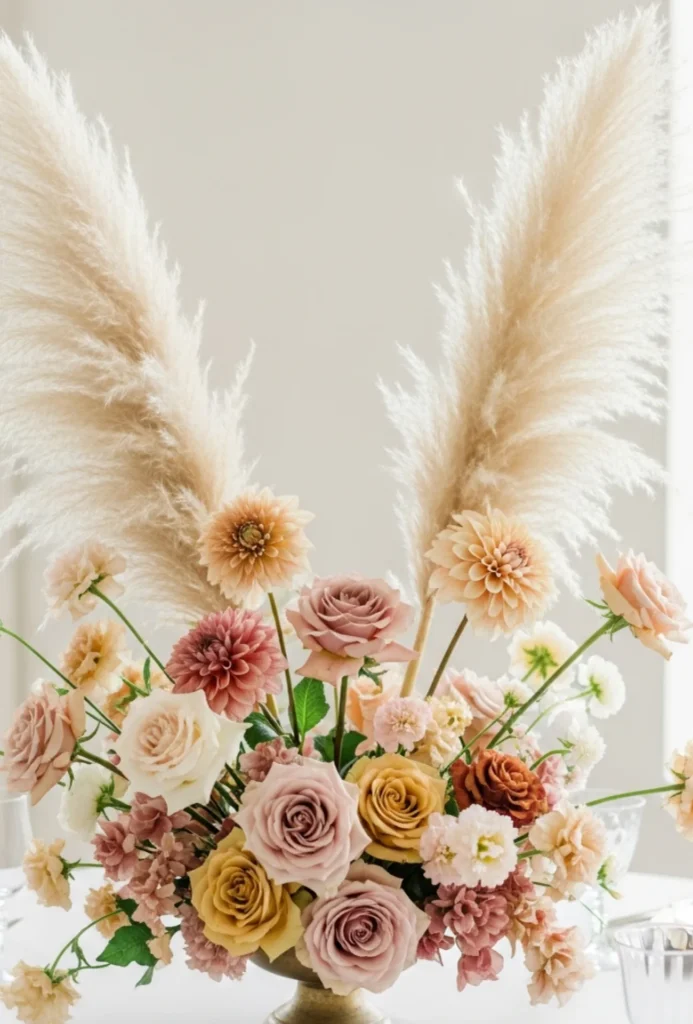
The combination of soft, feathery pampas grass with loose, romantic blooms is one of the defining aesthetic combinations of contemporary boho party styling.
The contrast between the whisper-light pampas plumes and the full, rounded shapes of flowers like dahlias and roses is visually perfect.
Arrange pampas stems at the tallest height within the centerpiece, letting their plumes fan outward above everything else.
Fill in the middle section with full-headed blooms in warm neutrals, dusty pinks, terracotta, and rust. Add dried seed heads, dried bunny tails, and preserved leaves throughout for additional texture.
Place in a woven rattan basket, a terracotta pot, or a simple cream ceramic vessel for the full boho effect. The vessel choice completes the whole aesthetic direction.
- Choose pampas in natural, bleached, or blush tinted tones for the softest boho palette
- Fluff pampas plumes gently before arranging by shaking the stem and separating the fibers
- Include dried artichoke or thistle heads for unexpected structural interest
- Boho arrangements look best slightly undone and generous rather than tightly controlled
29. Vintage Vessel Arrangements
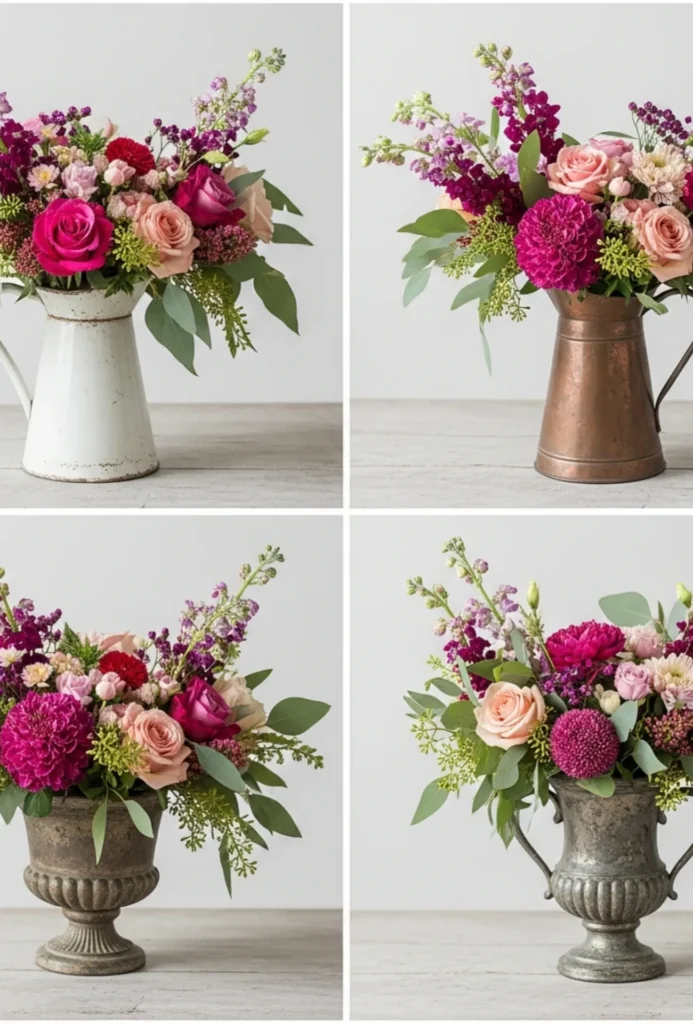
The vessel tells half the story in a floral centerpiece and a beautiful antique or vintage container elevates even the simplest arrangement into something with history and character.
Old vessels have a warmth that new containers simply have not had time to develop.
Source vintage pitchers, old medicine bottles, antique copper urns, grandmother’s ceramic vases, old silver julep cups, or weathered stone planters.
The patina, imperfection, and individual history of each piece gives the arrangement a context that feels genuinely collected and personal rather than purchased as a set.
A mix of different vintage vessels clustered together each holding a few stems creates a centerpiece that feels like a beautiful accident, as though these pieces simply found each other naturally.
- Thrift stores, estate sales, and antique markets are the best sources for interesting vessels
- The arrangement inside a vintage vessel should feel as relaxed and natural as the vessel itself
- Mix metals, ceramics, and glass in different ages and origins for the most interesting cluster
- A single extraordinary antique vessel holding a simple arrangement outshines a collection of ordinary vases every time
30. Dome Shaped Dense Florals
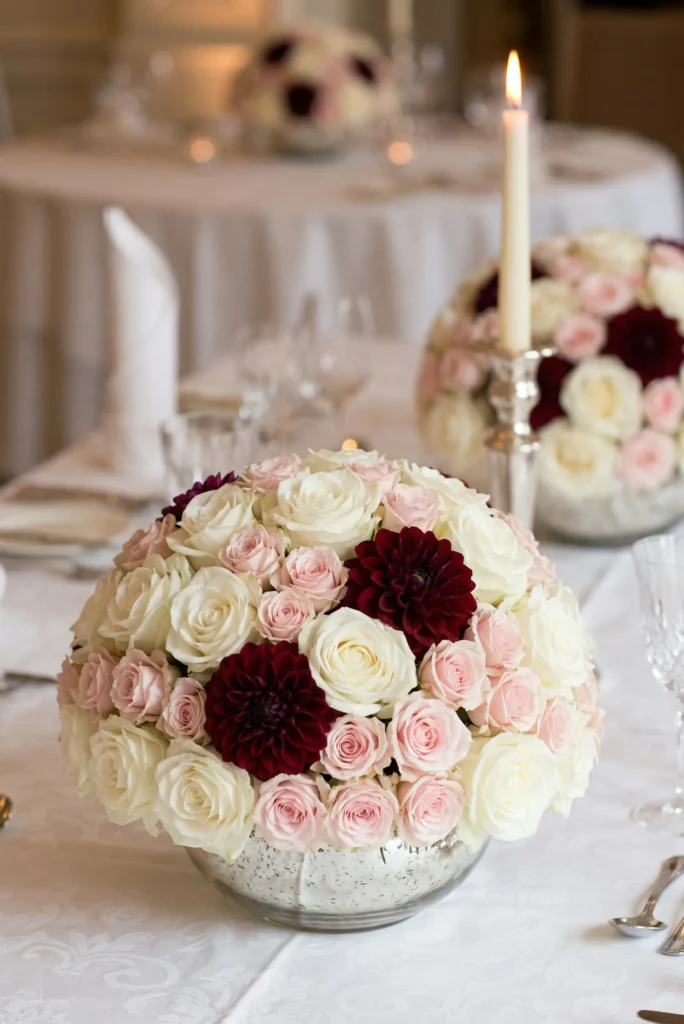
A perfectly domed floral arrangement, tight, full, and completely rounded, is a classic of formal floral design that still looks extraordinary when executed well.
The geometric precision of the dome shape in contrast with the organic softness of the flowers is genuinely beautiful.
Build the dome by working from the outer edge upward and inward, keeping the height and width in a consistent ratio throughout.
Use flower heads of similar size packed tightly together so no gaps appear anywhere across the surface. The finished dome should look continuous and unbroken from any angle.
This style suits formal dinners, wedding receptions, and any event where a classic, highly polished aesthetic is the intention. A pair of matching domes flanking a candle column looks completely magnificent.
- Use a round foam base soaked in water and placed in a low vessel as the foundation
- Begin with your most uniform bloom type to establish the dome shape before adding variety
- Check the arrangement from eye level while seated to ensure the dome reads correctly
- Add two or three accent blooms in a contrasting color for a focal point within the dome
31. Airy Florals with Branches
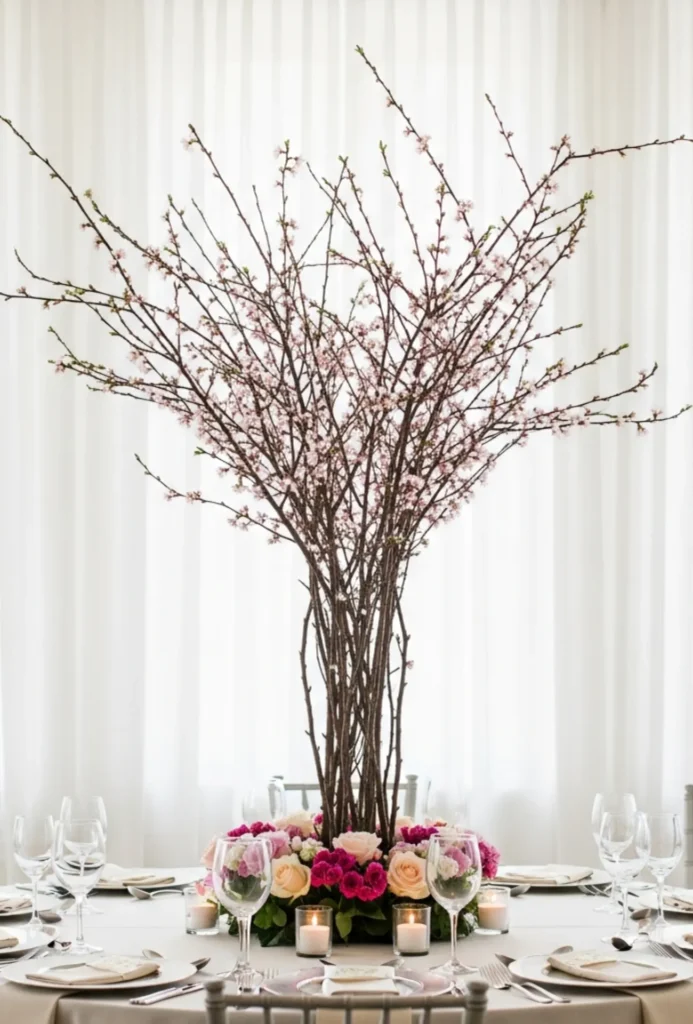
Adding flowering or bare branches to a floral arrangement instantly gives it extraordinary height and an airy, open quality that conventional flower stems alone cannot achieve. The branches create a sense of scale and reach that transforms the entire character of the display.
Use cherry blossom branches in spring, apple or pear blossom in early summer, bare sculptural branches in autumn and winter, or eucalyptus branches year-round. Establish the branch structure first as the tallest, most reaching elements.
Build the floral arrangement around and below the branches, keeping the lower section generous and full while letting the branches reach upward into clear space above.
The contrast between the dense lower floral portion and the open, reaching branch elements creates an arrangement with genuine drama and a sense of living landscape.
- Source branches from the garden or a florist supplier rather than cutting from trees without permission
- Condition branches by cutting the stem ends and splitting them vertically for better water uptake
- Cherry blossom branches should be cut at the early bud stage for longest display life
- The negative space created by branches above the arrangement is as important as the flowers below
32. Floral & Pearl/Crystal Accents
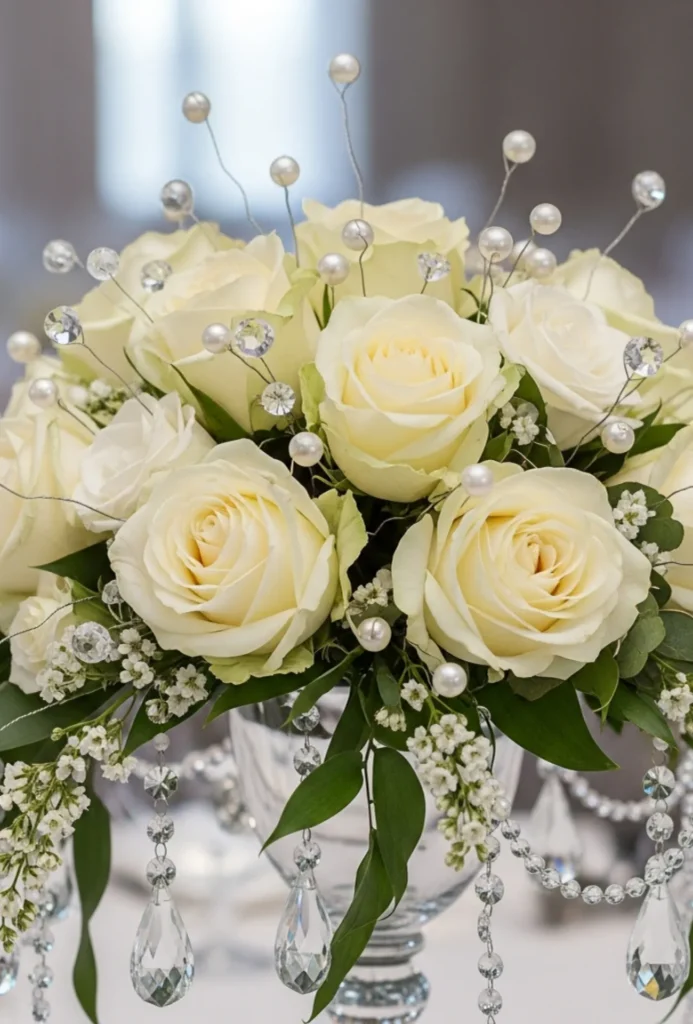
Adding pearls, crystals, or glass beads into a floral arrangement introduces a subtle luxury and shimmer that lifts the entire display into something that feels genuinely special and celebratory.
Wire individual pearl pins or crystal picks and insert them throughout a lush arrangement so they catch the light from within the flowers.
Crystal droplets hanging from arrangement wires, pearl-headed pins pushed into the hearts of open roses, and glass bead garlands draped gently through greenery all add sparkle without overpowering the natural beauty of the flowers.
This technique suits wedding centerpieces, engagement parties, anniversary dinners, and any occasion where a sense of luxury and occasion is the desired feeling.
- Use pearl-headed corsage pins for the easiest and most versatile method of adding pearl accents
- Vary the placement of crystals throughout the arrangement so they catch light from multiple angles
- Crystal drops hung from wire stems that extend above the arrangement catch overhead light beautifully
- Keep the crystal and pearl additions subtle so they enhance rather than compete with the flowers
Floral centerpieces are one of the most personal and expressive forms of decoration available to us, and the most beautiful ones always tell a story about the occasion they were created for.
Which of these 32 styles speaks most to your own aesthetic, and do you think the flowers you choose for a celebration say something deeper about what that moment means to you?