How to Style a Coffee Table from Scratch (Step-by-Step for Beginners)
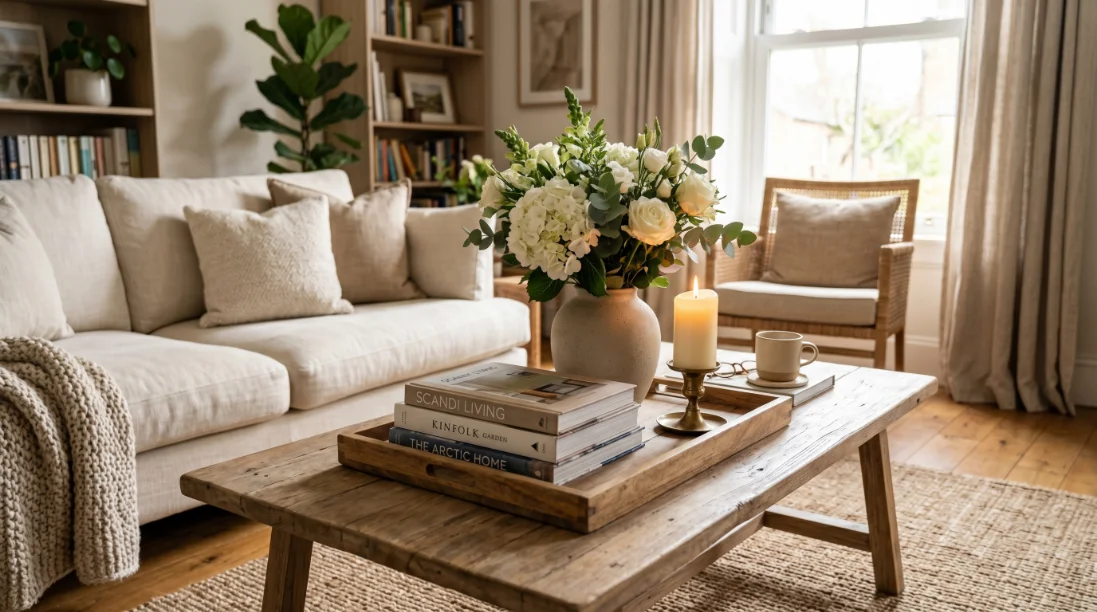
Your coffee table is the first thing people notice when they walk into your living room. It’s also the most restyled and second-guessed surface in the home. Most beginners either pile on too much or leave it looking bare and forgotten. This guide fixes that. You’ll get a clear, step-by-step process that works on any table, any budget, and any style. No design experience needed.
Let’s be honest. You’ve rearranged your coffee table three times, stepped back, and still thought: something’s off.
You’re not alone. The coffee table is one of the most styled and re-styled surfaces in any home. It sits dead center in your living room, it catches every guest’s eye, and it has to be both beautiful and usable at the same time.
That’s a tough job for a piece of furniture.
The good news is this: there’s a repeatable process that works every single time. Once you understand it, you can style any coffee table, any shape, any size, any budget, and feel confident about how it looks.
This guide will walk you through the whole thing, from scratch.
The Hidden Impact of Your Coffee Table on Your Living Room
The coffee table isn’t just a place to rest your drink. It’s the visual anchor of your living room.
Every person who walks into that space will instinctively glance at it. It sets the tone for the entire room. A bare table makes a room feel unfinished. An overloaded table makes it feel chaotic. The sweet spot is somewhere in between, layered, intentional, and livable.
Interior designers often say the coffee table is where a room’s personality lives. Your books, your candles, the little object you picked up on that trip. It tells a story about who you are. Getting that story right is worth the effort.
Before You Touch a Single Object
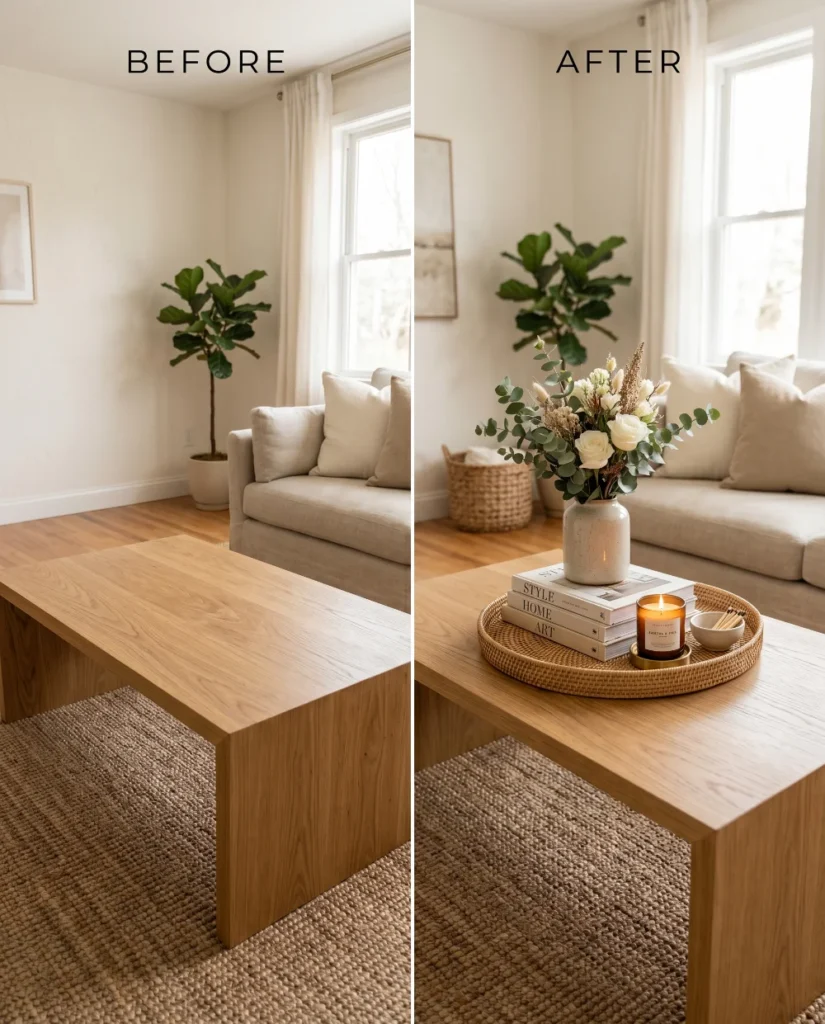
Most beginners make the mistake of jumping straight to decorating. They pile things on, step back, hate it, and give up.
Slow down first. Ask yourself two questions.
1. How do you actually use this table?
If you have kids who dump their snacks here every afternoon, you need clear usable space. If it’s in a formal living room that rarely gets used, you can go more decorative. If guests always set drinks down without coasters, you need a tray or bowl that guides them where to put things.
Your lifestyle shapes your styling choices. A good-looking table that doesn’t work for your life will be cleared off in a week.
2. What’s already in the room?
Look at your sofa, rug, and curtains. What colors are already there? What textures? Your coffee table should feel like it belongs to the room, not like it was styled in isolation.
Pull one or two colors from the room and carry them onto the table. This is the single easiest way to make everything look cohesive.
PRO TIP
Before you start, clear the table completely. Starting from empty is always easier than trying to edit a cluttered surface. Put everything on the floor, assess what you actually want back on the table, and build from zero.
The 5-Layer Coffee Table Formula
Every well-styled coffee table you’ve ever admired, whether in a magazine, on Pinterest, or in a designer showroom, follows some version of this framework.
Think of it as five layers, stacked in order.
Layer 1: The Foundation (Tray or Anchor Object)
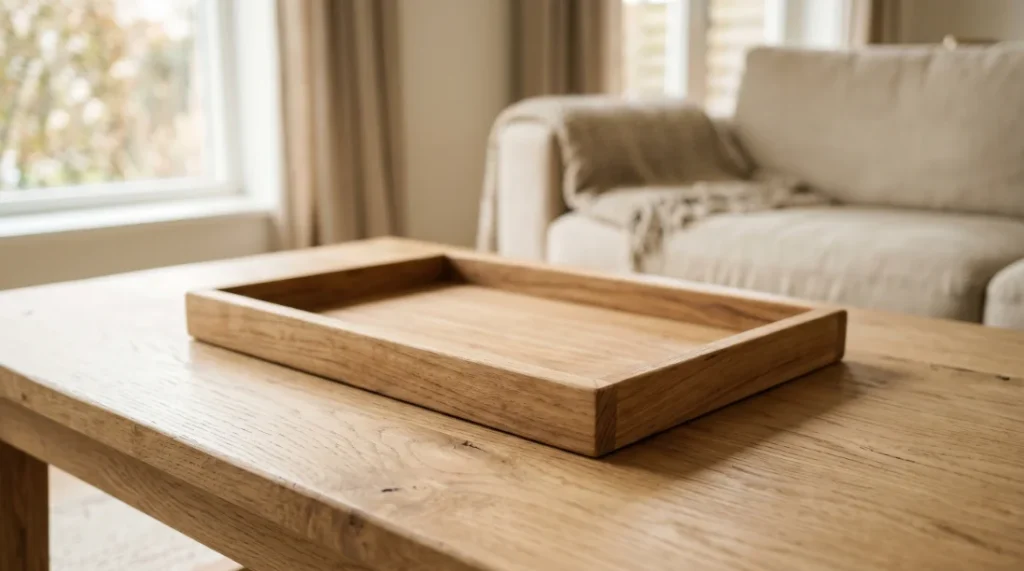
Start with something that creates a boundary. A tray is the most practical option because it groups items together and gives your arrangement a clear edge. Without it, objects scatter and the table looks random.
Use a rectangular tray on a rectangular table. Use a round tray on a round or square table. The shape should echo the table’s geometry.
A wide wooden bread board, a stone slab, or even a stack of large books can also serve as your anchor.
Layer 2: Height (Books or a Tall Object)
A flat arrangement is a dead arrangement. You need height variation to create visual interest.
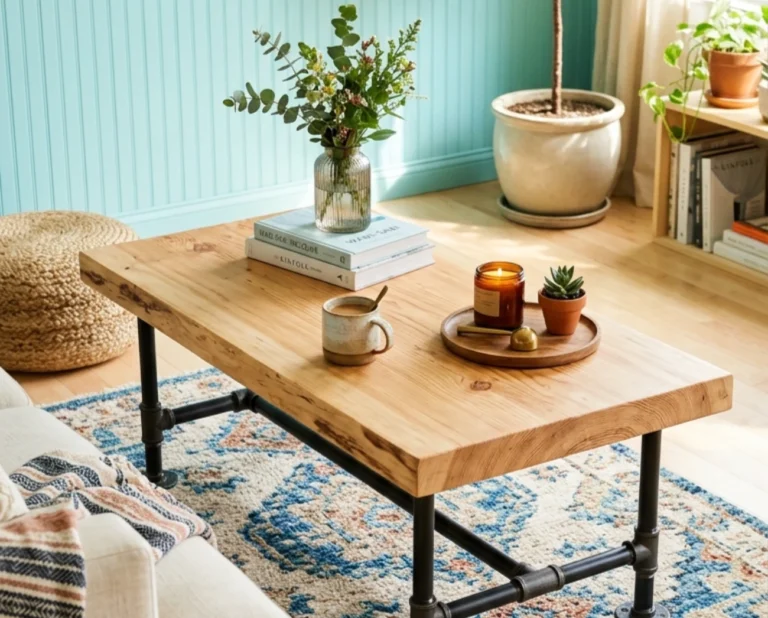
Coffee table books are the easiest way to add height. Stack two or three books horizontally, then place a smaller object on top. Vary the stack heights. Don’t line up three equal piles. One taller, one medium, one short.
If you want a single tall element instead, try a sculptural vase, a candlestick, or a small lamp. Just make sure it doesn’t block sightlines when people are seated.
Layer 3: Something Living
This is, arguably, the most important element on the table.
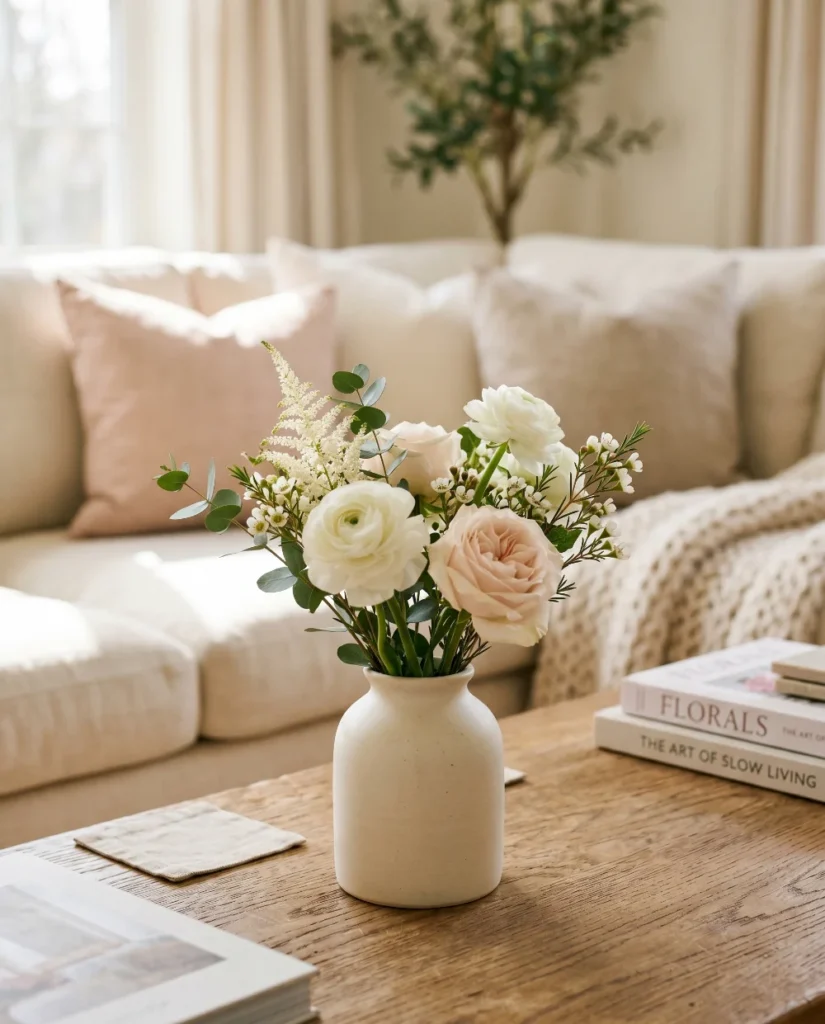
A plant or flowers instantly make a styled table feel real rather than staged. It adds life, softness, and color in a way that no decorative object can replicate.
Fresh flowers are always the best option. When they’re not available or practical, try a small potted plant. Orchids are a reliable choice. They last for weeks with minimal watering. Trailing pothos or a sprig of eucalyptus in a small vase also work beautifully.
Avoid artificial plants unless they’re extremely high quality. A cheap fake plant reads as cheap, full stop.
Layer 4: A Texture or Object of Interest
This is the layer that gives the table its personality.
Think decorative objects: a small marble sphere, a woven basket, a ceramic bowl, a piece of driftwood, an interesting stone. These are things you’ve collected, things that mean something to you, or things that simply look beautiful up close.
Choose objects with tactile quality. Things people want to pick up and turn over. That instinct to touch something is a sign the styling is working.
Texture matters on the table surface too. If your table is smooth glass or marble, you need textured objects to compensate. If the table itself has texture, rough wood, woven rattan, you can work with smoother objects.
Layer 5: A Functional Catch-All
This is the practical layer most guides skip. And it’s the reason your table gets cluttered within a week.
Put a small bowl, box, or basket on the table specifically for the things that always end up there anyway: remote controls, a phone, hair clips, keys. When those items have a designated home, the table stays styled.
A lidded box keeps things completely hidden. An open bowl works if the items inside are small and consistent. A small woven basket hides remotes and keeps the aesthetic intact.
Step-by-Step: Building Your Vignette
Now let’s put it together. Follow these steps in order and you’ll have a styled table in under 30 minutes.
Step 01
Clear Everything and Clean the Surface
Remove every item from the table. Wipe it down. Starting clean is not optional. It resets your eye so you stop seeing what was there and start seeing what could be there.
Step 02
Place Your Tray or Foundation
Set your tray, board, or anchor object. For a rectangular table, place it slightly off-center rather than perfectly centered. Off-center arrangements almost always look more natural and less forced.
Step 03
Build Your Book Stack
Choose two or three hardcover books. Remove the dust jackets if they clash with your color palette. Stack them horizontally and place them inside or beside your tray. Vary the heights. Don’t overthink the titles. Face them away from the room if you prefer a cleaner look. A good rule: choose books with spines in neutral tones (white, cream, grey, tan) or colors already present in your room.
Step 04
Add Something Living
Place your plant or flowers. If using a vase, make sure it’s proportionate to the table, not so tall that it dominates, not so small that it disappears. A vase that reaches about 12 to 14 inches is a safe starting point for most tables. Position the flowers or plant at one end of the tray, not in the dead center.
Step 05
Place Your Texture Object
Add your decorative object. Place it in the opposite corner from your flowers to create balance without symmetry. Symmetrical arrangements look stiff. Balanced but asymmetrical arrangements look intentional.
Step 06
Add the Practical Catch-All
Place your bowl or box outside the tray, at the other end of the table. This gives it a clear purpose and keeps it from looking like an afterthought.
Step 07
Step Back and Edit
Stand back at the same height your guests will view the table. That’s seated height, roughly from your sofa or chair. Does anything compete for attention? Remove it. Is there an awkward gap? Fill it with a small candle or a single book. Edit down until only the essentials remain.
How to Style Based on Table Shape
| Table Shape | Best Approach | Number of Zones |
|---|---|---|
| Rectangular | Divide into two or three sections along the length | 2–3 |
| Square | Use one large central tray with objects grouped tightly | 1–2 |
| Round | Create one central arrangement; avoid stiff symmetry | 1 |
| Oval | Treat like rectangular: two loose groupings with breathing room. | 2 |
| Nesting tables | Style the largest; keep the smaller ones purposefully lighter | 1 primary |
Round Tables: Keep It Simple
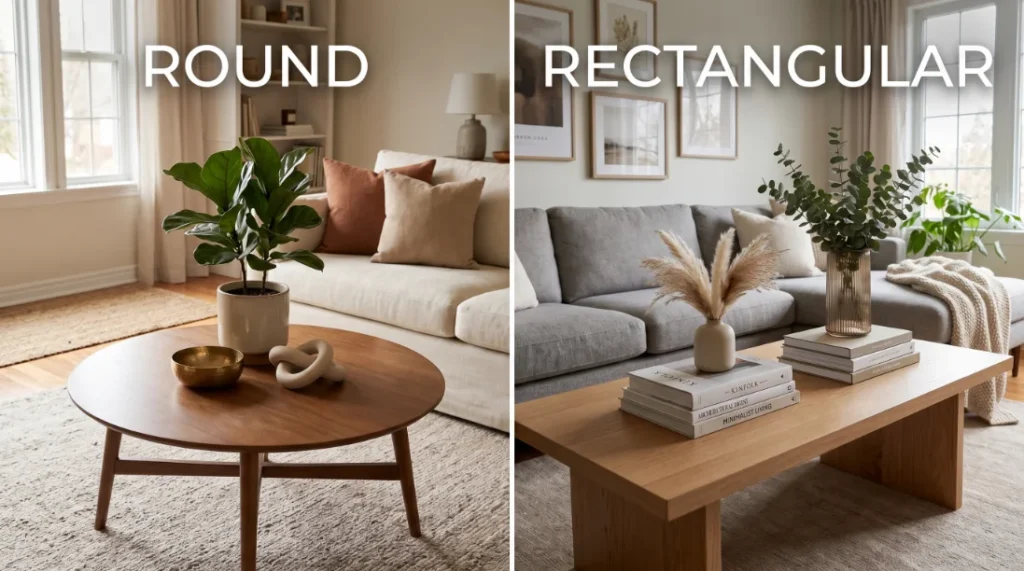
A round table needs a single central moment. One beautiful object, a large orchid, a sculptural bowl, a lantern with a candle inside. Then surround it with one or two lower elements at the edge. Don’t crowd the surface. The table shape itself is the design feature; let it breathe.
Rectangular Tables: Think in Zones
Mentally divide the table into thirds (or halves if it’s small). Each zone gets its own grouping. The tallest object belongs in the middle or back third. Leave some open surface visible in each zone. A fully covered table feels anxious.
7 Mistakes That Make Coffee Tables Look Wrong
Common Coffee Table Styling Mistakes
Using too many items of the same height. Flat arrangements look staged and lifeless. Vary your heights intentionally.
Ignoring scale. One enormous vase on a small table. Three tiny objects on a large table. Scale mismatches make rooms feel off.
No living element. An all-object arrangement always feels a little cold. Plants and flowers solve this immediately.
Perfectly centered, perfectly symmetrical arrangements. Real rooms don’t look like catalog shoots. Allow some asymmetry.
Too many colors. If every object is a different color, nothing reads as intentional. Stick to two or three colors maximum.
Forgetting function. If there’s nowhere to put a cup of coffee, you’ll clear the table in frustration within days.
Styling in isolation. Your coffee table should relate to the room around it. If everything in the room is warm-toned and your table is full of chrome and cool blue, it won’t feel cohesive.
Refreshing Your Table Each Season
You don’t need to redecorate your entire living room to keep things feeling fresh. The coffee table is the fastest, cheapest way to update the feel of a room throughout the year.
The trick is to keep your foundation pieces constant and swap out just one or two seasonal elements.
Spring and Summer
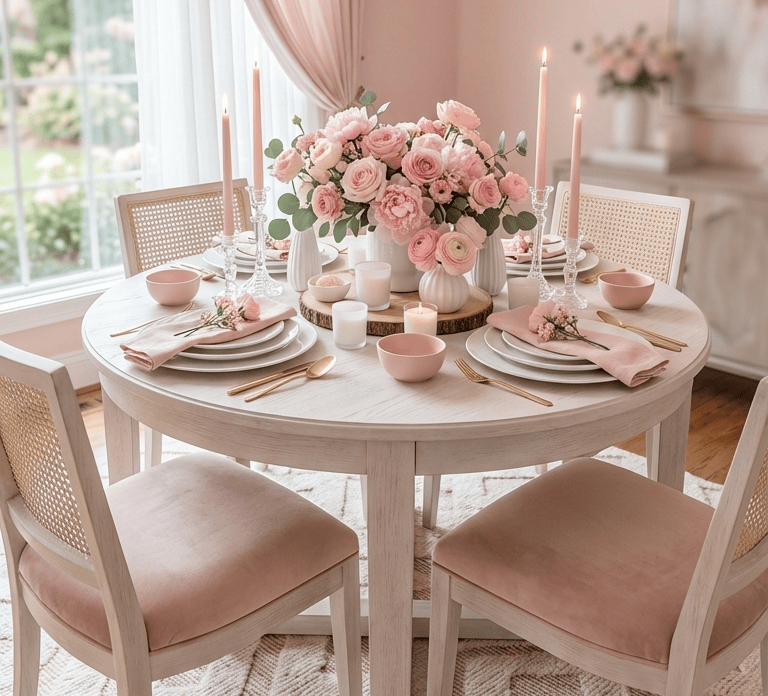
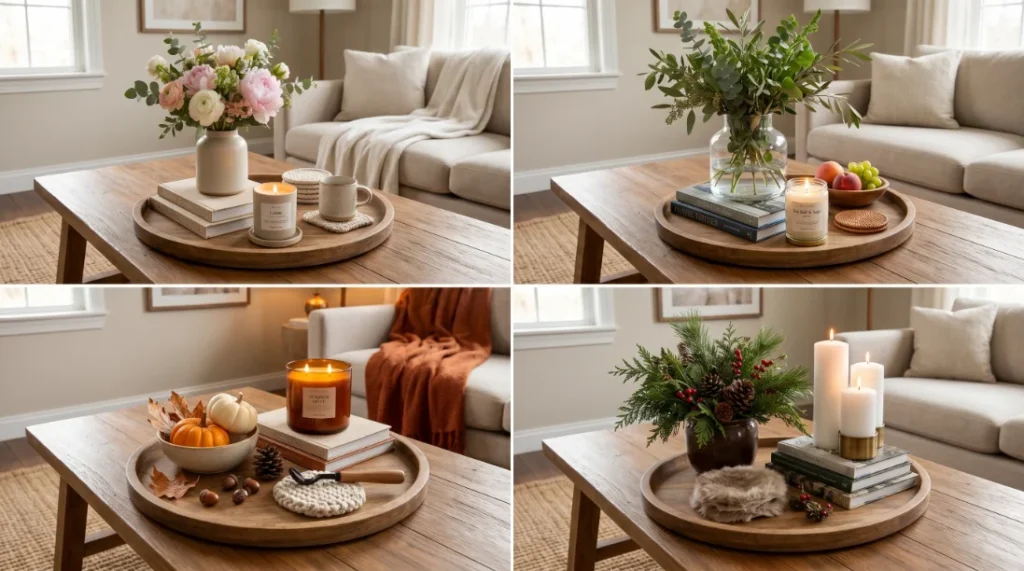
Lighten the palette. Bring in white or blush florals, a linen-covered book, something with a woven texture. Replace the heavy candle with a bud vase. Clear glass and light ceramics work well in warmer months.
Fall
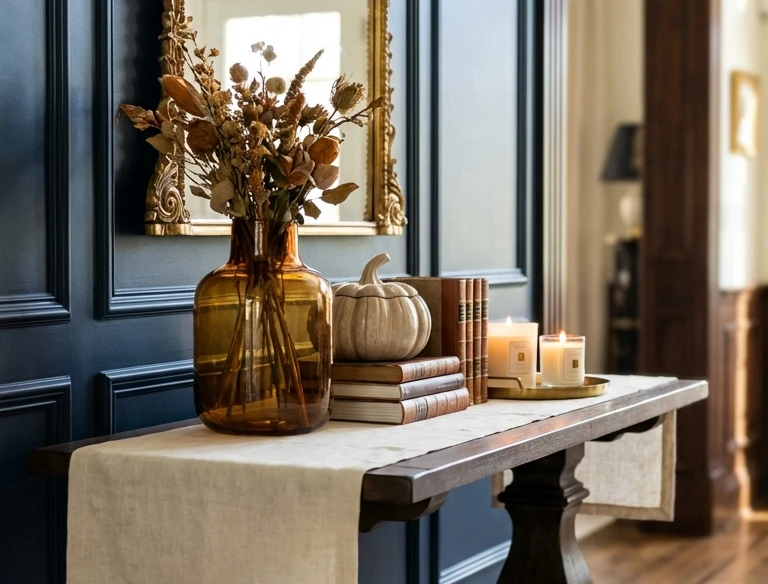
Warm up the tones. A small pumpkin or gourd sits perfectly on top of a book stack. Dried botanicals, amber-toned candles, and objects in rust, camel, or olive move the table naturally toward autumn without going overboard.
Winter and Holidays
This is when candles earn their place. Group two or three in varying heights. Add a small sprig of evergreen or a pinecone. Keep the palette tight: all white, or deep green and brass, or soft red and natural wood. Restraint always looks more elegant than excess during the holidays.
PRO TIP
Keep a small box in your linen closet or storage space for off-season coffee table items. Swap them out seasonally the same way you rotate throw pillows. You’ll always have something fresh ready to go.
Quick Shopping List: What You Actually Need
You don’t need to buy everything at once. Start with these five items and build from there.
- One tray (wood, marble, or rattan; avoid shiny metallic for a beginner setup).
- Two to three hardcover books in complementary colors
- One medium-sized vase (ceramic works in almost any style)
- One candle in a simple holder (unscented for living areas where scents may compete)
- One small decorative object with texture (a stone, a wooden sphere, a small ceramic piece)
That’s genuinely all you need. Everything else, the seasonal flowers, the additional books, the catch-all bowl, comes later as you develop your own style.
Frequently Asked Questions
How many items should be on a coffee table?
There’s no magic number, but five to seven items is a useful starting range for most tables. The real measure is whether each item looks intentional and whether there’s still open surface visible. If you can’t see the table itself, you have too much on it.
Should everything on a coffee table match?
No. Matching everything looks stiff and catalog-like. You want items that relate to each other through a shared color, material, or texture, not items that are identical. Think ‘cohesive,’ not ‘matching.
How do I style a coffee table with kids or pets?
Prioritize practical items that can survive contact. A sturdy tray corrals things and is easy to lift off the table when needed. Skip fragile objects. A woven basket for toys or remotes is your best friend. Keep plants on a high shelf rather than on the table.
Can I style a coffee table on a budget?
Absolutely. Thrift stores and secondhand shops are excellent sources for books, ceramics, and trays at a fraction of retail prices. A single bunch of grocery store flowers costs very little and makes more visual impact than most decorative objects. Start small and add over time.
What’s the most common mistake beginners make?
Putting everything at the same height. That single change, varying your heights, will instantly make any arrangement look more professional. Stack books, use a taller vase, place small items on top of books. Height variation is the clearest signal that something was styled with intention.
Do I need a tray on my coffee table?
You don’t need one, but it helps enormously. A tray creates a natural boundary for your arrangement and makes the whole thing look more organized even when it’s not. Without one, objects tend to drift and the arrangement loses structure. If you don’t want a tray, a flat stone slab or a stack of oversized books can serve the same anchoring purpose.
Wrapping Up
The coffee table is one of those surfaces that rewards a little patience. Take your time with it, edit ruthlessly, and don’t be afraid to restart. The more you do it, the faster your eye develops. Eventually you’ll walk into a room and immediately know what’s missing or what’s one item too many. That instinct is worth building.
Start with the tray. Add some books. Find a plant you love. The rest will follow.